
✅ Current for tax year 2026
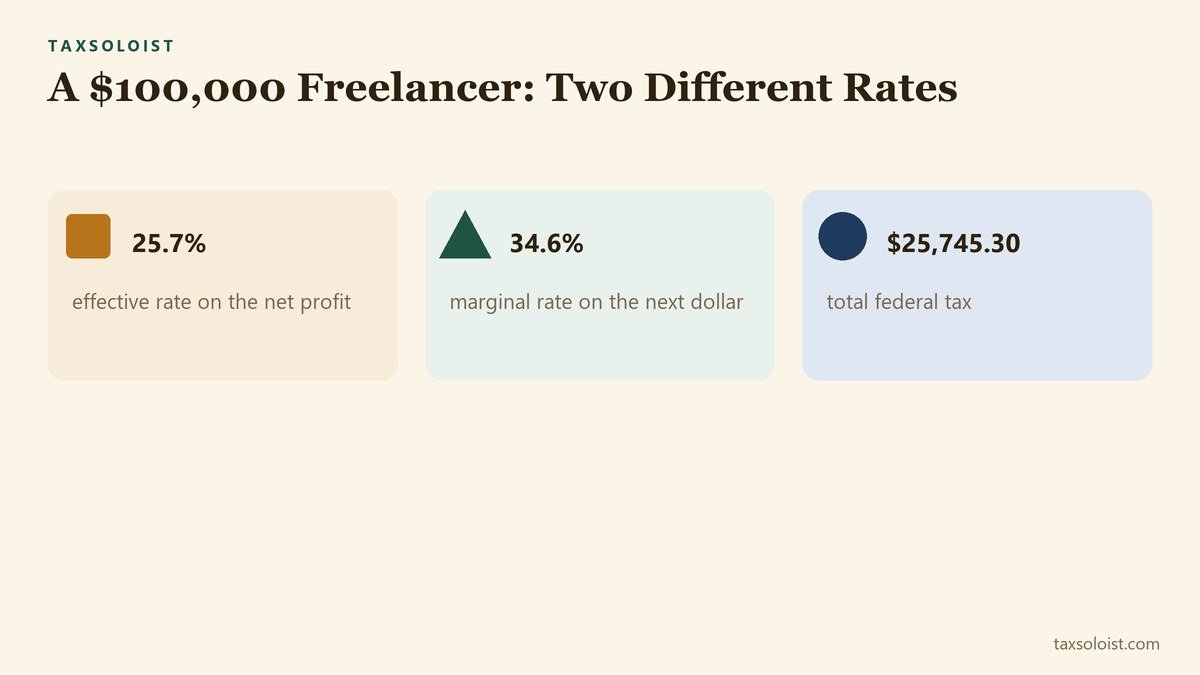
Quick answer: Your marginal tax rate is the tax rate on your next dollar of income. Your effective tax rate is your total tax divided by your income. Because federal income tax uses brackets, the effective rate is always lower than the top bracket you reach. To calculate your effective rate, add up all the tax you owe (federal income tax, self-employment tax and any state tax) and divide by the income you want to measure, such as net profit or taxable income. If you are self-employed, self-employment tax is a second layer that raises both numbers. In the 2026 example below, a single freelancer with $100,000 of profit pays about $25,745 of federal tax, an effective rate of about 25.7%, while the next dollar of profit is taxed at about 34.6%.
In this guide
- Marginal vs. effective rate in plain words
- How federal tax liability is calculated
- The self-employed twist: a second tax on the same profit
- Worked example 1: a freelancer with $100,000 of net profit
- Worked example 2: a married couple with $120,000 of taxable income
- Worked example 3: working backward from the take-home pay you want
- Calculate your effective and marginal rate
- Which rate should you use?
- Common questions
- Bottom line
- Sources
Marginal vs. effective rate in plain words
Federal income tax is progressive. You do not pay one rate on all your income: each slice of taxable income is taxed at the rate for its bracket. The rate on the top slice is your marginal rate. If you earn $1 more, that is the rate that applies to it, and if you deduct $1 more, that is the rate that saves you tax. The effective rate is the average, and it is the right number to use when you want to know how much of your income goes to tax. A common myth is that moving into a higher bracket makes the whole income taxable at the higher rate. It does not; only the dollars above the bracket line are taxed at the higher rate.
Be clear about the denominator. The same tax bill gives different effective rates depending on whether you divide by gross receipts, net profit, adjusted gross income or taxable income. For planning a freelance budget, net profit is usually the most useful, because it is what you can actually spend or save before tax.
How federal tax liability is calculated
- Total your income: business net profit, wages, interest and other income.
- Subtract adjustments such as half of self-employment tax, retirement plan deductions and the self-employed health insurance deduction. The result is adjusted gross income (AGI); see AGI for the self-employed.
- Subtract the standard deduction or itemized deductions, and any qualified business income deduction you are entitled to. The result is taxable income.
- Apply the brackets to taxable income to get income tax.
- Subtract credits and add other taxes such as self-employment tax and the additional Medicare tax.
- Compare with payments (withholding and estimated tax) to see what you owe or are due back.
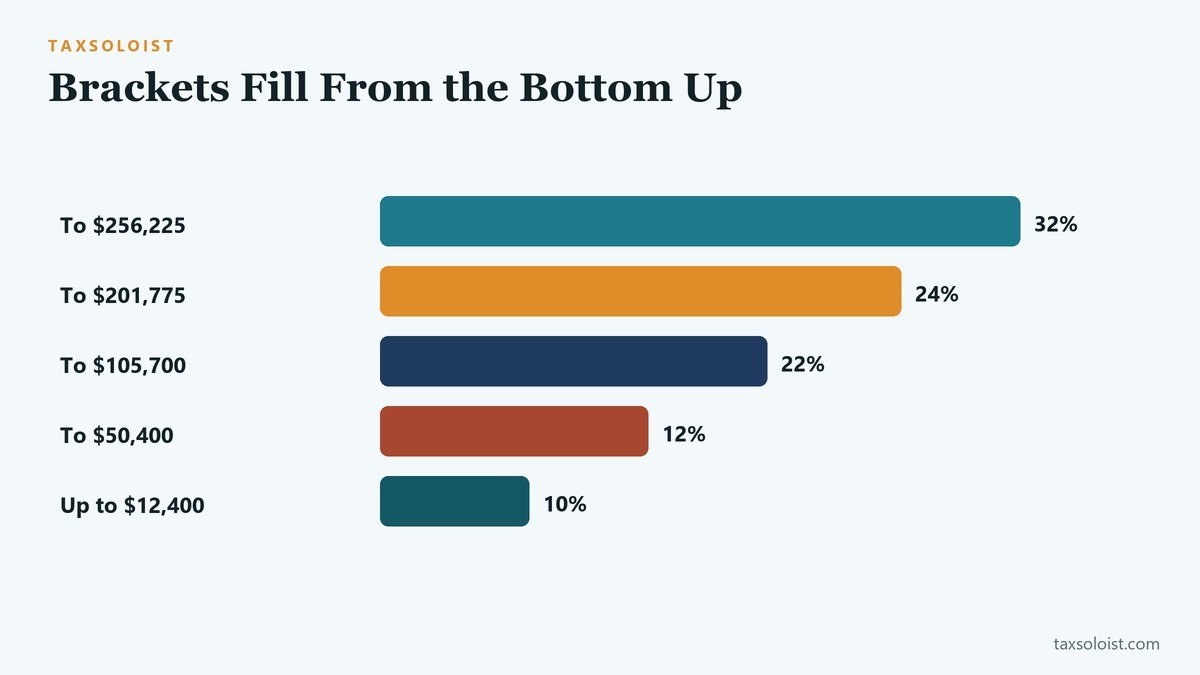
For 2026 the standard deduction is $16,100 for single filers, $32,200 for married couples filing jointly and $24,150 for head of household. The single brackets are 10% up to $12,400, 12% to $50,400, 22% to $105,700, 24% to $201,775, 32% to $256,225, 35% to $640,600 and 37% above. For joint filers they are 10% up to $24,800, 12% to $100,800, 22% to $211,400, 24% to $403,550, 32% to $512,450, 35% to $768,700 and 37% above. These are federal numbers only; most states add their own income tax, so add your state tax to get a combined rate. Our tax deduction calculator and take-home pay calculator can help you estimate the pieces.
| Rate | Single: taxable income up to | Married filing jointly: up to |
|---|---|---|
| 10% | $12,400 | $24,800 |
| 12% | $50,400 | $100,800 |
| 22% | $105,700 | $211,400 |
| 24% | $201,775 | $403,550 |
| 32% | $256,225 | $512,450 |
| 35% | $640,600 | $768,700 |
| 37% | Above $640,600 | Above $768,700 |
| Standard deduction (2026) | $16,100 | $32,200 |
The self-employed twist: a second tax on the same profit
If you work for yourself, you also pay self-employment tax. According to the IRS, you usually owe it if your net earnings from self-employment are $400 or more, and the amount subject to the tax is generally 92.35% of your net earnings. The rate is 12.4% for Social Security (up to a yearly wage base, which is $184,500 for 2026) plus 2.9% for Medicare with no cap, for 15.3% in total below the wage base. You can deduct one-half of the self-employment tax when figuring AGI. If your income is high enough, an additional 0.9% Medicare tax applies above $200,000 for single filers, $250,000 for joint filers and $125,000 for married filing separately; those thresholds are not indexed for inflation. The self-employment tax calculator and the Social Security tax guide go deeper.
The result is that a self-employed person’s marginal rate is the income tax bracket plus about 14.1% of self-employment tax (15.3% times 92.35%), reduced a little because half of the self-employment tax is deductible. Once your earnings pass the Social Security wage base, the marginal self-employment tax drops to about 2.7% (2.9% times 92.35%).
Worked example 1: a freelancer with $100,000 of net profit
Kai is a single freelancer with $100,000 of net profit in 2026 and no other income. Assumptions: standard deduction, no credits and no qualified business income deduction (which could lower taxable income further).
| Item | Amount |
|---|---|
| Self-employment tax | $100,000 times 92.35% is $92,350. Social Security at 12.4% is $11,451.40 and Medicare at 2.9% is $2,678.15, for $14,129.55. |
| AGI | $100,000 minus half of the SE tax ($7,064.78) is $92,935.22. |
| Taxable income | $92,935.22 minus $16,100 is $76,835.22. |
| Income tax | $1,240 on the first $12,400, plus $4,560 (12% on $38,000), plus $5,815.75 (22% on $26,435.22), which is $11,615.75. |
| Total federal tax | $14,129.55 plus $11,615.75 is $25,745.30. |
Kai’s effective rate is about 25.7% of net profit ($25,745 divided by $100,000). Income tax alone is about 11.6% of profit, or about 15.1% of taxable income. Kai’s marginal rate is about 34.6%: an extra dollar of profit adds about 14.1 cents of self-employment tax, and after the half-SE-tax deduction about 93 cents of it is taxed at 22%, for about 20.4 cents. That is why a business expense or a retirement-plan deduction can be worth more than the headline bracket suggests for a freelancer. For example, a $1,000 deductible business expense reduces taxes by roughly $346 here, not $220, because it lowers both income tax and self-employment tax. Compare the deduction side in our complete list of self-employed deductions.
| Step (Kai, single, $100,000 net profit, 2026) | Amount |
|---|---|
| Self-employment tax | $14,129.55 |
| Adjusted gross income (profit minus half of SE tax) | $92,935.22 |
| Taxable income (minus $16,100 standard deduction) | $76,835.22 |
| Income tax | $11,615.75 |
| Total federal tax | $25,745.30 |
| Effective rate on net profit | about 25.7% |
| Marginal rate | about 34.6% |
Worked example 2: a married couple with $120,000 of taxable income
Sam and Lee are married, file jointly, and have $120,000 of taxable income after deductions, all from wages with employer withholding.
- Tax: $2,480 on the first $24,800, plus $9,120 (12% on $76,000), plus $4,224 (22% on $19,200), which is $15,824.
- Effective rate: $15,824 divided by $120,000 is about 13.2% of taxable income.
- Marginal rate: 22%.
If Lee earns $5,000 more, only that $5,000 is taxed at 22%, or $1,100 more tax. The couple’s earlier $115,000 is not retaxed. If they cross into the next bracket at $211,400 of taxable income, only the dollars above that line are taxed at 24%.
Worked example 3: working backward from the take-home pay you want
Many people ask an inverse question: how much do I need to earn to take home a certain amount? Say Kai wants $60,000 left after federal income tax and self-employment tax. You cannot divide $60,000 by one minus the 22% bracket or by one minus the 34.6% marginal rate, because both are the wrong rate: the rate that applies to the whole amount is the effective rate, which changes as profit changes. Instead, work forward with trial amounts until the result lands on your goal.
- Try $78,000 of profit: SE tax $11,021, income tax $7,118, take-home $59,861 (too low).
- Try $78,300: SE tax $11,063, income tax $7,179, take-home $60,058 (slightly above).
- Solve it exactly: about $78,212 of profit leaves $60,000: SE tax about $11,051 and income tax about $7,161, for an effective federal rate of about 23.3%.
In a spreadsheet, put the take-home formula in one cell and use Goal Seek (or a few quick trials) to find the profit that gives the result you want. Add your state income tax in the same formula if you have one. Remember that this example ignores credits, the qualified business income deduction and state tax, so the real answer will differ.
A related question is backing the tax out of a total. If a price including sales tax is $1,085 and the tax rate is 8.5%, the pre-tax price is $1,085 divided by 1.085, or $1,000, and the tax is $85.
| Profit tried | SE tax | Income tax | Take-home |
|---|---|---|---|
| $78,000 | $11,021 | $7,118 | $59,861 (too low) |
| $78,300 | $11,063 | $7,179 | $60,058 (slightly above) |
| about $78,212 (exact) | about $11,051 | about $7,161 | $60,000 |
Calculate your effective and marginal rate
Enter your net self-employment profit and any other wages. The calculator uses the 2026 brackets, standard deduction and self-employment tax rules and shows your total federal tax, effective rate and approximate marginal rate. It ignores credits, the QBI deduction and state tax.
This calculator needs JavaScript.
Which rate should you use?
- Use the effective rate to budget: set aside that share of net profit for tax, and plan quarterly estimated payments around it. The 1099 quarterly tax calculator does this for you.
- Use the marginal rate to value decisions at the edge: a deduction, an extra client, a retirement contribution (see how much a 401(k) contribution reduces your taxes and IRA deduction limits) or whether a bracket line is close.
- Add state and local tax for a combined rate. Some people also face the alternative minimum tax in unusual years.
Common questions
Can a raise reduce my take-home pay?
No. Only the extra dollars are taxed at the higher rate. Some credits and deductions phase out as income rises, which can make the real marginal rate higher than the bracket rate, but a raise does not cause lower take-home pay from brackets alone.
Is my effective rate the same as my tax bracket?
No. Your bracket is your marginal rate. Your effective rate is lower.
Do I include self-employment tax in my effective rate?
For planning, yes. It is a federal tax on the same profit, and for many freelancers it is the largest piece.
Where do I find my own effective rate?
Divide the total tax on your Form 1040 (plus any state tax) by the income you want to measure, such as AGI or net profit.
Bottom line
Know both numbers. Your marginal rate tells you what the next dollar costs or saves; your effective rate tells you what share of your income goes to tax. If you work for yourself, include self-employment tax in both, add state tax, and use trial amounts or a spreadsheet when you need to work backward from a take-home target. These examples are estimates for 2026 and ignore credits and the qualified business income deduction, so ask a tax professional before you rely on them.
Related guides
- Self-Employment Tax Calculator
- Take-Home Pay Calculator
- 1099 Quarterly Tax Calculator
- How to Calculate Quarterly Estimated Taxes for the Self-Employed
- Tax Deduction Calculator
- AGI for the Self-Employed
- Social Security Tax for the Self-Employed
- Self-Employed Tax Deductions: The Complete List for 2026
- Can Gig Workers Claim the QBI Deduction Without an LLC or Sole Proprietorship?
- Married Filing Jointly and Self-Employed Withholding
- AMT in 2026: Exemption, Phase-Out, and Who Still Owes It
- How Much Does a 401(k) Contribution Reduce Your Taxes?
- IRA Deduction Limits for 2026
- After-Tax Cost of Debt: Formula, Example, and Business Interest Deductibility
- Standard Deduction for 2025 and 2026, Including the Extra Amounts for Seniors
Sources
- IRS Revenue Procedure 2025-32: 2026 inflation adjustments (brackets and standard deduction)
- IRS: Tax inflation adjustments for tax year 2026
- IRS Topic no. 554: Self-employment tax
- IRS Topic no. 751: Social Security and Medicare withholding rates
- IRS Instructions for Form 8959: Additional Medicare Tax