
✅ Current for tax year 2026
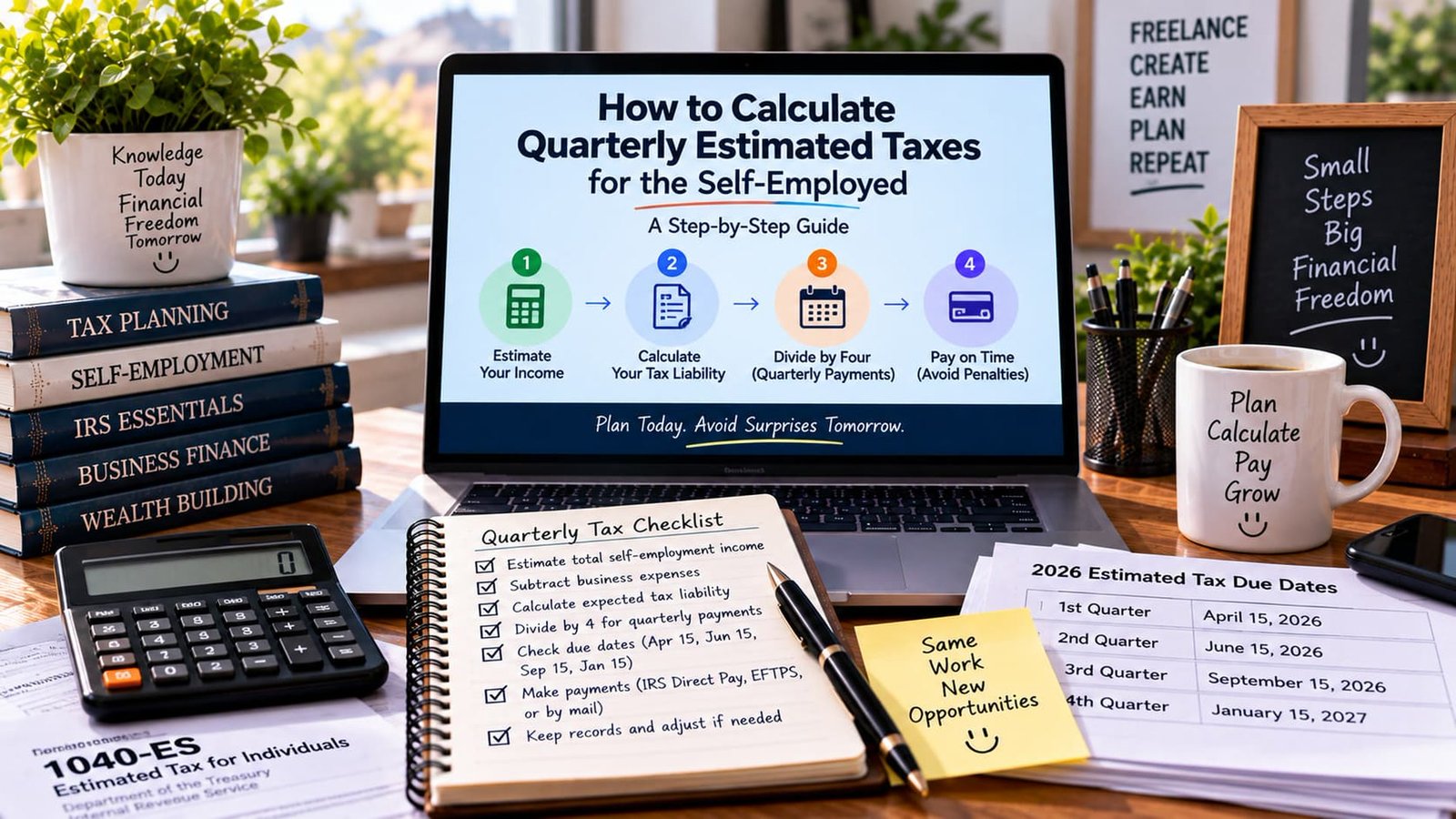
Quick answer: Estimate your income, calculate what you’ll actually owe on it, divide by four, and pay on time each quarter — a four-step process that gets easier and more accurate every time you repeat it.
Why this exists
Nothing is withheld from self-employment income, but the IRS still expects tax paid throughout the year, not just at filing time. Form 1040-ES is how you pay it in four installments instead of a paycheck-by-paycheck deduction. Skip it, and you risk an underpayment penalty stacked on top of the tax itself — a genuinely avoidable cost.
Step 1: Estimate your income
Start with a realistic projection of your total self-employment income for the year — not what you hope to earn, what your actual trend suggests, updated as the year progresses. If you’re new to self-employment and have no history to go on, err toward a slightly conservative-but-honest estimate and revise it after your first full quarter of real numbers.
Step 2: Calculate your tax liability
Subtract your expected business expenses from that income to get projected net profit, then run it through the Self-Employment Tax Calculator to get your Social Security and Medicare tax. Add your estimated income tax on top, based on your bracket, filing status, and expected deductions — including the deduction for half your self-employment tax.
Step 3: Divide by four
Take your total estimated tax liability for the year and split it into four roughly equal quarterly payments. If your income is seasonal or uneven, you’re allowed to pay unequal amounts that better match when the income actually arrives (using the annualized income installment method) — but the simple even-split approach is the right starting point for most self-employed filers.
Step 4: Pay on time
Mark the deadlines and pay through IRS Direct Pay, EFTPS, or by mail — whichever method fits your workflow, as long as it’s on time. Use the 1099 & Quarterly Tax Calculator each quarter with your updated year-to-date numbers rather than relying on a single estimate made back in January.
- 1st Quarter — April 15, 2026
- 2nd Quarter — June 15, 2026
- 3rd Quarter — September 15, 2026
- 4th Quarter — January 15, 2027
| Item | Example |
|---|---|
| Projected net profit | $60,000 |
| Estimated self-employment tax | ~$8,478 (15.3% of 92.35% of profit) |
| Estimated income tax (illustrative) | ~$5,000 (varies by bracket, deductions, filing status) |
| Estimated total tax | ~$13,478 |
| Per-quarter payment | ~$3,370 |
Illustrative numbers only — your actual bracket, deductions, and credits change the real figure. Use the calculators linked above with your own numbers.
The safe harbor shortcut
If projecting income tax precisely feels overwhelming, the IRS gives you a simpler target: pay in at least 90% of what you’ll owe this year, or 100% (110% for higher earners) of what you owed last year — whichever is smaller — and you generally avoid the underpayment penalty even if your final bill is higher. This same safe harbor concept is covered in more depth in Married Filing Jointly: Handling Withholding When One Spouse Is Self-Employed.
The quarterly checklist
- Estimate total self-employment income
- Subtract business expenses
- Calculate expected tax liability
- Divide by 4 for quarterly payments
- Check the due dates each quarter
- Make the payment (IRS Direct Pay, EFTPS, or by mail)
- Keep records and adjust the next quarter if needed
Adjusting mid-year
Your Q1 estimate doesn’t have to match your Q4 payment — if income picks up or slows down, recalculate and adjust the remaining quarters rather than sticking rigidly to your original number. This is exactly the habit that keeps the process manageable year after year instead of a once-a-year scramble.
What happens if you miss a quarterly deadline entirely
Missing one quarter doesn’t mean you’ve lost the ability to pay — you can still make a late payment for that quarter, though the IRS may calculate a small underpayment penalty for the period the payment was late, generally based on the current interest rate applied to the amount and duration of the shortfall. It’s rarely catastrophic, but it does add unnecessary cost, and it’s straightforward to avoid with a calendar reminder rather than relying on memory alone.
Using last year’s tax as a shortcut for a stable-income year
If your income is relatively stable year to year, one of the simplest ways to set your quarterly payments is to base them on 100% (110% if you’re a higher earner) of what you actually owed last year, divided by four — this satisfies the safe harbor rule automatically regardless of how this year’s income actually turns out, removing the need to project this year’s numbers precisely. This approach works less well if your income is growing quickly or highly variable, where a current-year estimate tends to be more accurate.

State estimated taxes, briefly
Most states with an income tax have their own version of quarterly estimated payments, often on a similar (though not always identical) schedule to the federal deadlines. Don’t assume paying your federal quarterly estimate automatically covers your state obligation — check your specific state’s requirements separately, since state underpayment penalties are calculated independently of federal ones.
Why some self-employed filers choose to overpay slightly
Rather than calculating quarterly payments to the exact dollar, some self-employed filers deliberately round up or add a small buffer to each payment, treating the difference as a form of forced savings that comes back as a refund rather than risking an underpayment penalty from a slightly-off projection. This isn’t necessary if your calculations are solid, but for a first-year freelancer still building confidence in their own income projections, a small buffer can reduce anxiety considerably at a relatively low cost — an interest-free overpayment refunded later, rather than a penalty for guessing low.
Automating the habit so it doesn’t rely on memory
The freelancers who manage quarterly taxes with the least stress tend to automate as much of the process as possible: a separate savings account that a fixed percentage of every client payment gets automatically transferred into, calendar reminders set a week before each deadline (not on the deadline itself), and a recurring quarterly check-in to recalculate based on actual year-to-date income. None of this requires special software — just a deliberate system set up once and followed consistently.
What to do in your very first year of self-employment
First-year self-employed filers face a unique challenge: there’s no prior year’s tax bill to use as a safe harbor baseline, and income projections are often genuinely uncertain since there’s no track record to draw on. In this situation, it’s reasonable to make a conservative estimate for Q1, then recalculate more precisely for Q2 through Q4 once you have real data from the first quarter or two of actual income. The safe harbor rule based on the current year’s actual tax (the 90% threshold) becomes your main reference point in a first year, since the prior-year-based alternative simply doesn’t exist yet.
It’s also worth building extra caution into a first-year estimate specifically because the shift from W-2 withholding (which most new self-employed filers are used to) to self-managed quarterly payments is unfamiliar territory — a slightly conservative early estimate, corrected as the year goes on, tends to produce less stress than an aggressive estimate that turns out to be too low.
Bottom line
A rough, updated-every-quarter estimate beats a precise guess made once in January. Set a calendar reminder for each 1040-ES deadline and recalculate every time using your actual year-to-date numbers — the process compounds into real accuracy by the time Q4 comes around.
Related guides
- How to Pay Social Security Tax When You Are Self-Employed: A Step-by-Step IRS Guide
- How to Avoid Self-Employment Tax Legally: 9 Strategies That Work
- Do You Pay Self-Employment Tax on Rental Income?
- California Self-Employment Tax: What You Owe at the Federal and State Level
- How to Register as Self-Employed Without the Stress
- Freelance Writer Tax Deductions: The Complete Write-Off List for 1099 Writers
- Freelance Graphic Designer Tax Deductions: Software, Hardware, and Home Studio Costs
- Freelance Web Developer and Web Designer Tax Deductions: Software, Hosting, Coworking, and Gear
- Freelance Photographer Tax Write-Offs: Gear, Depreciation, Travel, and Studio Costs
- Hair Stylist Tax Write-Offs: Booth Rent vs. Commission, Supplies, and Licenses
- How to File Taxes as an Independent Contractor: Forms, Deadlines, and What You'll Actually Owe
- Last-Minute Tax Write-Offs: What You Can Still Do Before December 31 and Before You File
- Sports Betting and Prediction Market Winnings: How FanDuel and Kalshi Winnings Are Taxed