
✅ Current for tax year 2026
Think of this as a worksheet you can fill in with your own numbers. The question “are my benefits taxable?” has a precise answer, and it depends on a figure the IRS calls provisional income. At most 85% of your benefits are ever taxable, and many retirees with modest income pay nothing on them.
Step 1: calculate provisional income
Add these three items:
- Your adjusted gross income without counting Social Security (wages, pensions, IRA withdrawals, interest, dividends, taxable gains).
- Tax-exempt interest, such as municipal bond interest.
- Half of the Social Security benefits you received for the year (from Form SSA-1099, box 5).
Step 2: compare it with the thresholds
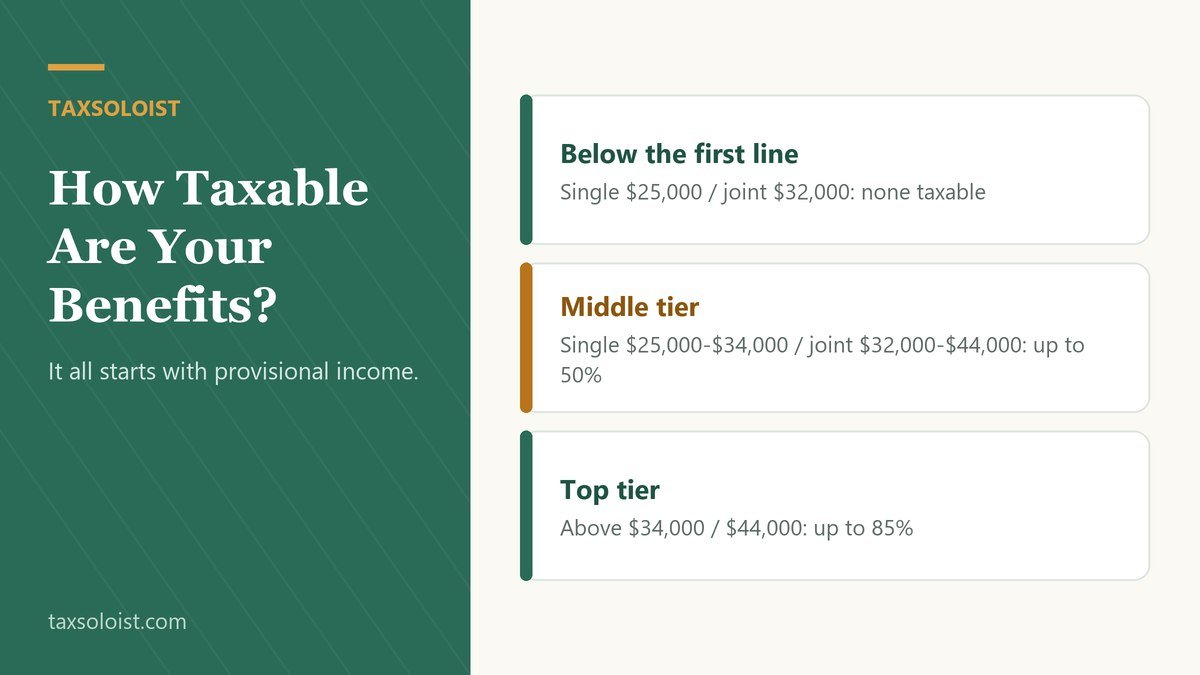
| Filing status | Nothing taxable at or below | Up to 50% taxable between | Up to 85% taxable above |
|---|---|---|---|
| Single, head of household, qualifying surviving spouse | $25,000 | $25,000 and $34,000 | $34,000 |
| Married filing jointly | $32,000 | $32,000 and $44,000 | $44,000 |
| Married filing separately, lived with spouse at any time in the year | $0 | Not applicable | Up to 85% taxable from the first dollar |
These base amounts are fixed by law and are not adjusted for inflation, which is why more retirees cross them each year.
Step 3: find the taxable amount
The IRS worksheet in Publication 915 is the official method. The shortcuts below show the logic behind it for the two main tiers; the taxable amount is never more than 85% of your benefits.
- Middle tier: taxable = the smaller of 50% of your benefits, or 50% of the amount provisional income exceeds the first threshold.
- Top tier: taxable = the smaller of 85% of your benefits, or 85% of the amount provisional income exceeds the second threshold plus the smaller of (50% of your benefits, or 50% of the gap between the two thresholds).
Case 1: single filer, middle tier
Benefits $24,000. Pension $18,000 and interest $2,000, so income excluding Social Security is $20,000. Half the benefits is $12,000.
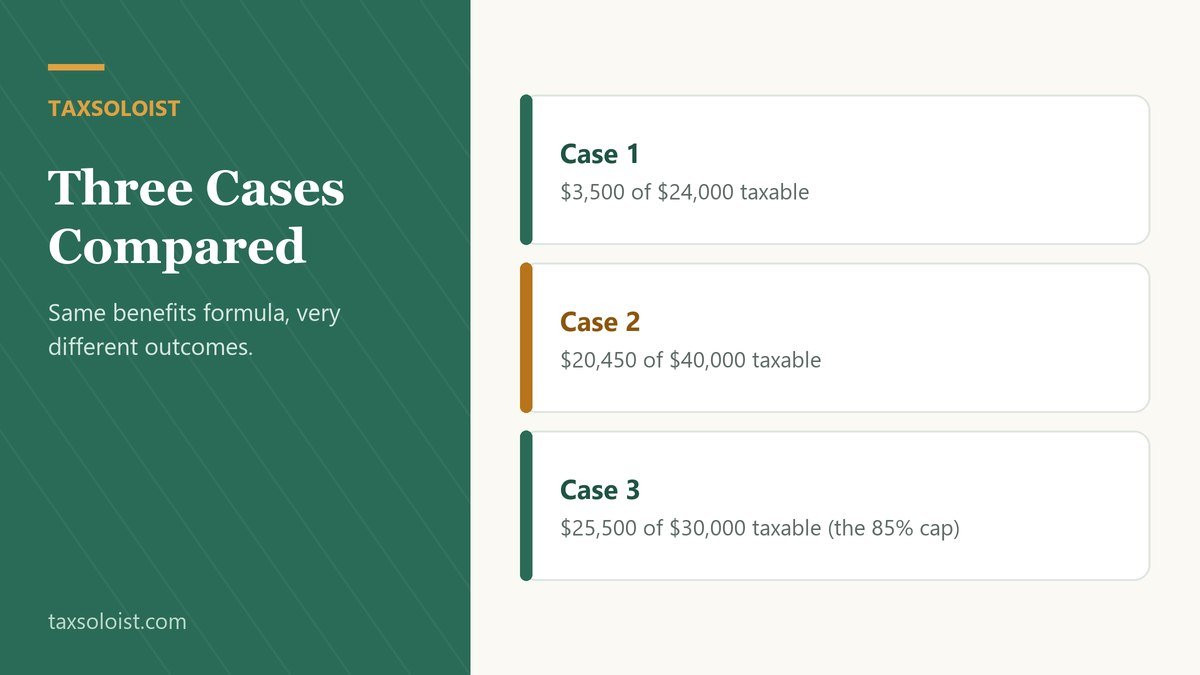
Provisional income: $20,000 + $12,000 = $32,000. That is between $25,000 and $34,000. The smaller of 50% of benefits ($12,000) or 50% of ($32,000 − $25,000) = $3,500 is $3,500. $3,500 is taxable, about 15% of the benefits.
Case 2: married couple, top tier
Benefits $40,000. Pension and IRA withdrawals total $40,000 and interest is $1,000, so income excluding Social Security is $41,000. Half the benefits is $20,000.
Provisional income: $41,000 + $20,000 = $61,000, above $44,000. 85% of ($61,000 − $44,000) is $14,450. The middle-tier piece is the smaller of $20,000 or 50% of ($44,000 − $32,000) = $6,000, so $6,000. Add them: $20,450. The cap is 85% of $40,000 = $34,000. $20,450 is taxable, about 51% of the benefits.
Case 3: single filer who reaches the cap
Benefits $30,000. Other income $60,000. Half the benefits is $15,000.
Provisional income: $60,000 + $15,000 = $75,000. 85% of ($75,000 − $34,000) is $34,850, plus the middle-tier piece, the smaller of $15,000 or 50% of ($34,000 − $25,000) = $4,500, gives $39,350. That exceeds 85% of benefits ($25,500), so the cap applies and $25,500 is taxable. The taxable portion is added to your other income and taxed at your normal brackets; it is not taxed at 85%.
Ways people manage the tax
- Withhold voluntarily. Form W-4V lets you have 7%, 10%, 12% or 22% of each benefit payment withheld. You can also make quarterly estimated payments; see how to calculate quarterly estimated taxes.
- Watch what raises provisional income. IRA withdrawals, Roth conversions and realized gains count; qualified Roth withdrawals do not. A Roth conversion in a year with Social Security can push more benefits into the taxable tier.
- Remember the state. Most states do not tax Social Security benefits, but a handful do, with their own exemptions. Check your state revenue agency before assuming.
If you also work and pay self-employment tax, the Social Security wage-base side of the system is covered in our self-employed Social Security tax guide. The two are separate: this page is about tax on benefits you receive.
Where the numbers come from
Social Security sends Form SSA-1099 in January. Box 3 shows the benefits paid and box 4 any repaid; box 5 is the net amount you use in the worksheet. If you also received railroad retirement benefits (tier 1), they have their own form, RRB-1099, and are treated the same way. Enter the full net benefit on Form 1040 line 6a and the taxable part on line 6b. Medicare premiums deducted from your benefit are included in the box 5 figure; they do not reduce it.
What raises provisional income without you noticing
- Required minimum distributions. Once RMDs begin, a larger IRA withdrawal can move you into the next tier even if your spending did not change.
- Selling investments. A taxable gain counts in adjusted gross income, so selling a position can make more of your benefits taxable. See capital gains rates for 2026.
- Roth conversions. The converted amount is taxable income. Converting in the year before you claim benefits, or in a low-income year, avoids stacking it on top of benefits.
- Tax-exempt interest. Municipal bond interest is not taxed but still counts in provisional income, which surprises many retirees.
- Part-time work. Wages and self-employment profit raise AGI. If you claim benefits before full retirement age, a separate earnings limit can also temporarily reduce your payments; ask Social Security how it applies to you.
Common mistakes
- Believing that benefits are taxed at 85%. The 85% is the maximum share of benefits included in income, not the tax rate.
- Forgetting the extra half. Half of your benefits is added to your income in the provisional income formula, even though the tax applies to the taxable part.
- Using the wrong base amount. Married couples filing separately who lived together face a $0 base, so up to 85% is taxable from the first dollar.
- Skipping withholding and then being surprised in April. Without withholding or estimated payments, tax on benefits arrives as a lump sum.
Do states tax Social Security?
Federal taxation is the same in every state. At the state level, most states exempt benefits entirely, but a small number tax some of them, usually with income-based exemptions that vary by age. Check your state revenue department for the current rule instead of relying on a list that may be out of date.
Related guides
- Social Security Tax for the Self-Employed
- Taxes on 401(k) and IRA Withdrawals
- Roth Conversion Taxes
- Standard Deduction Guide