

✅ Current for tax year 2026
When people say “the IRS penalty” they usually mean one of two different charges. One punishes not filing on time and the other punishes not paying on time. They have different rates, different caps, and they interact. The timeline below shows what the combination looks like, starting from month one.
The two penalties in one table
| Failure to file | Failure to pay | |
|---|---|---|
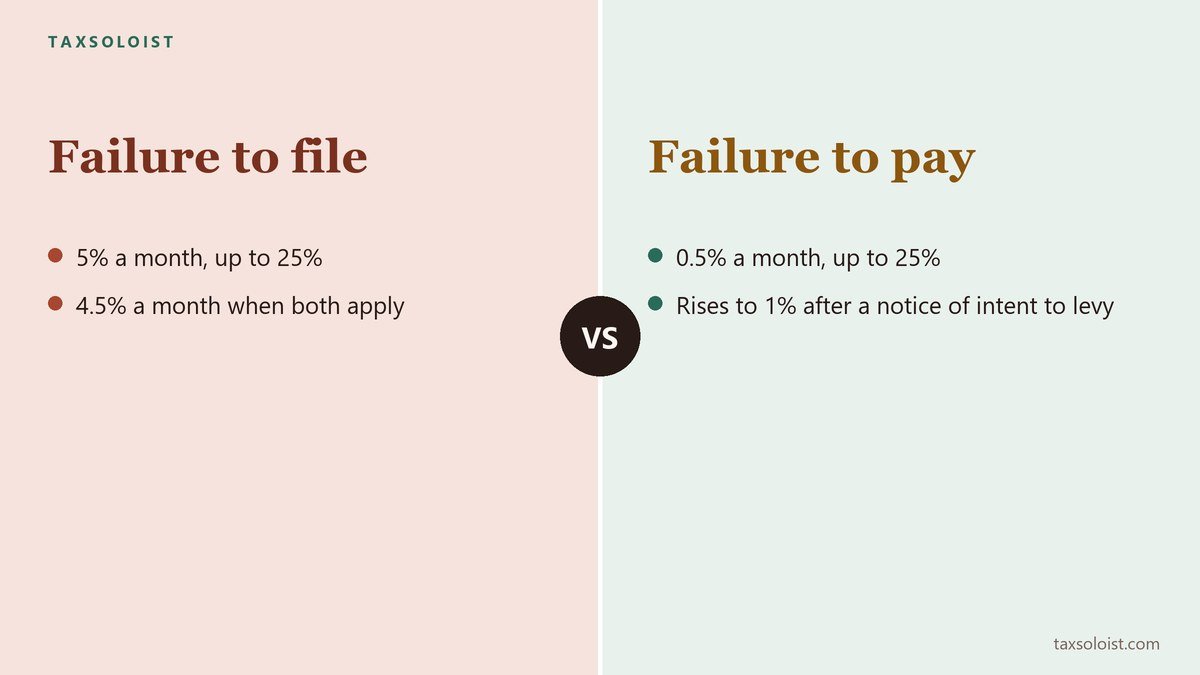
| Rate | 5% of the unpaid tax for each month or part of a month the return is late | 0.5% of the unpaid tax for each month or part of a month the tax is unpaid |
| Cap | 25% of the unpaid tax | 25% of the unpaid tax |
| When both apply | Reduced to 4.5% a month (the 0.5% failure-to-pay penalty is counted inside it) | 0.5% continues after the filing penalty maxes out |
| Return filed more than 60 days late | A minimum penalty applies: the smaller of a fixed dollar amount (see the IRS page) or 100% of the tax owed | Not applicable |
| After an IRS notice of intent to levy | Not applicable | Rises to 1% a month if still unpaid 10 days after the notice |
Interest is separate. It runs on the unpaid tax and on penalties from the due date until you pay, at a rate the IRS sets each quarter. The tables below leave interest out so you can see the penalties alone.
A month-by-month example
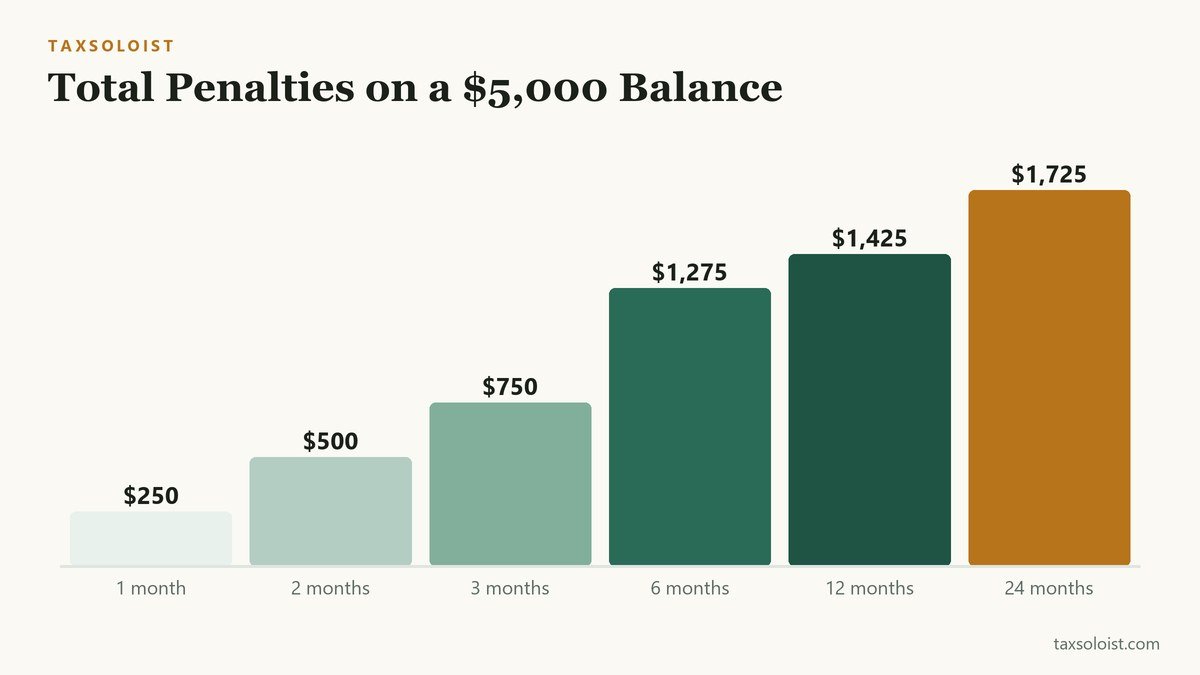
Assume a $5,000 balance due on the April deadline, with nothing paid and no return filed. For each row, the return is filed and the tax is paid at the end of that month.
| Months late | Filing penalty (4.5%/month) | Payment penalty (0.5%/month) | Total penalties |
|---|---|---|---|
| 1 | $225 | $25 | $250 |
| 2 | $450 | $50 | $500 |
| 3 | $675 | $75 | $750 |
| 4 | $900 | $100 | $1,000 |
| 5 | $1,125 (maximum reached) | $125 | $1,250 |
| 6 | $1,125 | $150 | $1,275 |
| 12 | $1,125 | $300 | $1,425 |
| 24 | $1,125 | $600 | $1,725 |
Two lessons stand out. First, the filing penalty is far heavier per month (4.5% versus 0.5%), so filing, even if you cannot pay, removes the biggest charge. Second, the payment penalty keeps running until the tax is paid or the 25% cap is reached, which at 0.5% a month takes 50 months.
What if you filed on time but cannot pay?
Then only the 0.5% penalty and interest apply. For the same $5,000 that is $25 a month, versus $250 in the first month had you not filed. If the IRS approves a payment plan and you filed on time, the rate drops to 0.25% a month during the plan. Details and fees are in our payment plan guide.
An extension does not extend the payment date
Filing for an extension gives you more time to file, not more time to pay. If you owe tax and pay after the original deadline, the failure-to-pay penalty runs from the original due date even though your return is not late. Estimate what you owe and pay it by the deadline; the rest can follow with the return. Self-employed readers should also keep up with estimated payments, since underpaying during the year can create a separate underpayment penalty.
Getting a penalty removed
- First-time penalty abatement. If your recent filing and payment history is clean, you can ask the IRS to waive a penalty for the year. The IRS penalty relief page lists the conditions.
- Reasonable cause. A serious illness, a natural disaster or inability to get records can qualify. Write down what happened, when, and what you did to fix it.
- Statutory exceptions and relief tied to specific disasters or IRS errors.
Interest on a penalty that is removed is removed too, but interest on the original tax is not. The simplest fix remains timing: file on time, pay what you can, and contact the IRS about the rest before a notice arrives.
Other penalties you might meet
- Underpayment of estimated tax. If you did not pay enough during the year through withholding or quarterly estimates, you can owe a penalty even if you file and pay on time. It is figured on Form 2210. Paying at least 90% of this year’s tax, or 100% of last year’s (110% for higher-income taxpayers), is the safe-harbor range most people use.
- Accuracy-related penalty. A 20% penalty can apply to an underpayment caused by negligence or a substantial understatement of income tax.
- Information return penalties. Businesses that file Forms W-2 and 1099 late or incorrectly can be charged per form; see what happens if a 1099 is missed.
How to read an IRS notice
- Find the notice number in the top right corner and the tax year it covers.
- Read what the IRS changed and the amount it says you owe, with the penalties and interest broken out.
- Look at the response date. Acting before it protects your appeal rights.
- Compare the notice with your return. If it is wrong, reply in writing with supporting documents; if it is right, pay or set up a plan.
How interest adds up
Interest is the federal short-term rate plus 3 percentage points, set every quarter, and it compounds daily on unpaid tax and on penalties. Because the rate changes, the IRS publishes the current number on its interest page. The effect: a balance left unpaid for a year costs more than the table of penalties alone suggests, which is another reason to pay as much as you can, as soon as you can.
Frequently asked questions
Which is worse, filing late or paying late?
Filing late costs far more per month. If you cannot pay, file anyway and then ask about a payment plan.
Do I owe a penalty if I am due a refund?
No. The failure-to-file and failure-to-pay penalties are calculated on tax you owe. Even so, a refund claim generally has to be filed within three years of the original due date, or you lose the refund.
What if I did not know I had to file?
Not knowing the rule is not a defense by itself, but the IRS considers all the facts when you ask for penalty relief. Explain what happened and show the steps you took once you found out.