
✅ Current for tax year 2026
Your filing status is the first choice on Form 1040 and it affects almost everything after it: the standard deduction, which tax brackets apply, and whether you can claim certain credits. For most people the answer is obvious. When it is not, work through the six questions below. Your status is set by your situation on December 31 of the tax year.
Six questions, in order
- Were you legally married on December 31? If yes, you are married for the whole year, even if you separated that spring. Go to question 2. If no, go to question 3.
- Married: filing together or apart? Most couples file jointly (MFJ), which is usually the lower-tax choice. Choose married filing separately (MFS) only for a specific reason, such as keeping tax liabilities apart. A spouse who lived apart for the last six months and supports a child may qualify for head of household.
- Did your spouse die in one of the two prior tax years, and do you have a dependent child? If yes, you may be a qualifying surviving spouse and can use joint rates.
- Are you unmarried and did you pay more than half of the cost of keeping up a home? Rent or mortgage, utilities, food and repairs count.
- Did a qualifying child or relative live with you more than half the year? (A dependent parent is the exception: they do not need to live with you.) If questions 4 and 5 are both yes, you can file as head of household (HOH).
- None of the above? You file as single.

The 2026 numbers for each status
| Status | Standard deduction | 10% bracket ends at | 12% bracket ends at |
|---|---|---|---|
| Single | $16,100 | $12,400 | $50,400 |
| Married filing jointly / qualifying surviving spouse | $32,200 | $24,800 | $100,800 |
| Head of household | $24,150 | $17,700 | $67,450 |
| Married filing separately | $16,100 | $12,400 | $50,400 |
Taxable-income figures; from IRS Rev. Proc. 2025-32. The extra standard deduction for age 65 or older or blind is $1,650 per person ($2,050 if unmarried and not a surviving spouse).
Example 1: joint or separate?
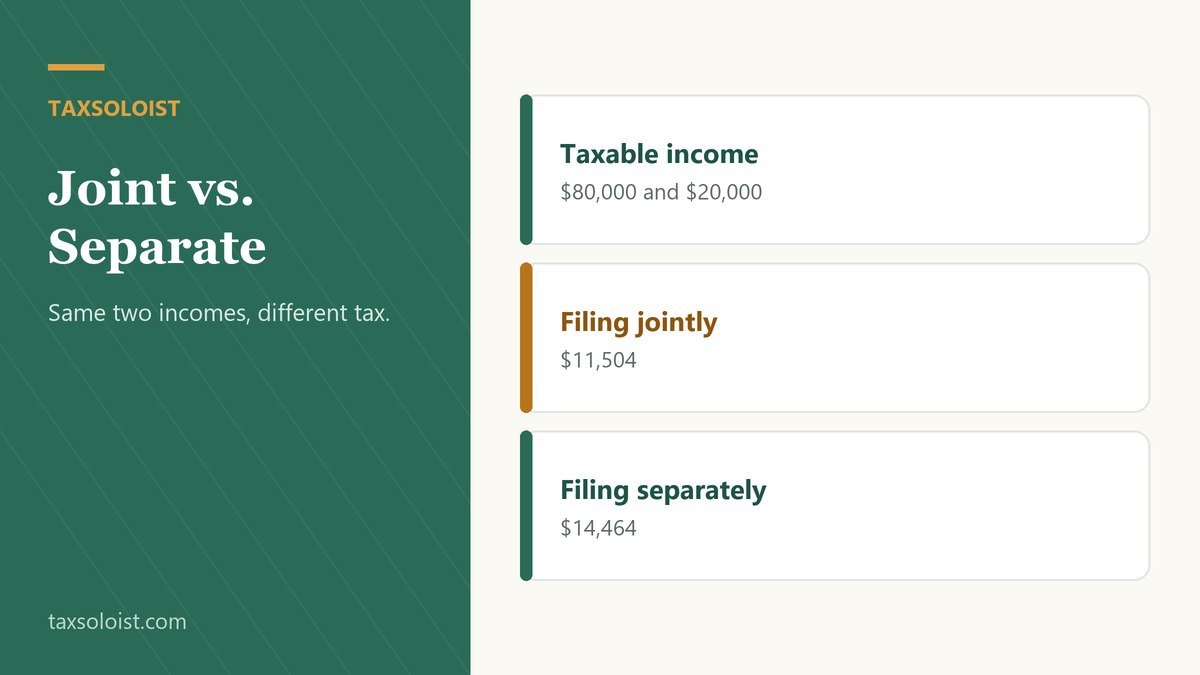
A couple has taxable income of $80,000 for one spouse and $20,000 for the other, $100,000 together. Filing jointly, the tax is $2,480 + 12% × ($100,000 − $24,800) = $2,480 + $9,024 = $11,504.
Filing separately, the spouse with $80,000 pays $5,800 + 22% × ($80,000 − $50,400) = $5,800 + $6,512 = $12,312, and the spouse with $20,000 pays $1,240 + 12% × ($20,000 − $12,400) = $1,240 + $912 = $2,152, for a total of $14,464. Filing jointly saves $2,960. A big gap like this is common when one spouse earns much more than the other.
Example 2: single or head of household?
Take $60,000 of taxable income. As a single filer the tax is $5,800 + 22% × ($60,000 − $50,400) = $7,912. As head of household it is $1,770 + 12% × ($60,000 − $17,700) = $6,846. That is $1,066 less at the same taxable income, and head of household also starts with an $8,050 higher standard deduction ($24,150 versus $16,100), which lowers taxable income further.
Why married couples sometimes file separately
- One spouse has large medical bills and the lower AGI makes the deduction threshold easier to reach.
- You want to be responsible only for your own return, for instance because of a spouse’s tax problems.
- One spouse is on an income-driven student loan repayment plan.
The trade-off is that MFS limits or removes several credits and deductions, and both spouses must treat deductions the same way: if one itemizes, so must the other. Run both versions before deciding.
Head of household traps
- You must be unmarried, or considered unmarried because you lived apart from your spouse for the last six months of the year.
- Paying for the home means more than half of its upkeep, not more than half of your own expenses.
- Your qualifying person has to live with you for more than half the year, apart from the parent exception.
Filing status also affects your paycheck: it is the first thing you choose on the Form W-4. For the brackets in more detail, see effective versus marginal tax rates, and the standard deduction guide for the amounts that go with each status.
Special situations
Divorce or separation near year end
Your marital status on December 31 controls the whole year. If your divorce is final on December 31, you file as single or head of household for that year. If it is final on January 1, you were married for the previous year and may file jointly or separately.
Your spouse died
In the year of death, the surviving spouse can generally file jointly with the deceased. For the next two years, a qualifying surviving spouse with a dependent child can use the joint rates and standard deduction. After that, head of household or single may apply.
A spouse who is a nonresident alien
You can file jointly if you and your spouse both agree to be taxed on worldwide income. Otherwise, you generally file as married filing separately, or as head of household if you qualify as considered unmarried.
Living apart but still married
Legally married people can file as head of household if they lived apart from their spouse for the last six months of the year, paid more than half the cost of the home, and meet the qualifying person test. Otherwise they file jointly or separately.
Can I change my filing status after filing?
You can switch from separate to joint by filing an amended return, generally within three years. You cannot switch from joint to separate after the due date of the return. That one-way door is why couples who are unsure should compare both options before the deadline.
Frequently asked questions
Does my filing status affect my credits?
Yes. Married filing separately limits or removes several credits and deductions, including education credits and the earned income credit in most cases. See the Child Tax Credit guide for how the income limits differ by status.
Which status gives the biggest standard deduction?
Married filing jointly and qualifying surviving spouse have the largest ($32,200 in 2026), then head of household ($24,150), then single and married filing separately ($16,100).
Can an unmarried couple file jointly?
No. Joint filing is only for married couples. Each unmarried partner files as single or head of household if qualified, and only one of them can claim a given child.
Related guides
- Standard Deduction Guide
- Effective vs. Marginal Tax Rate
- Withholding When Married and Self-Employed
- Child Tax Credit 2026