
✅ Current for tax year 2026
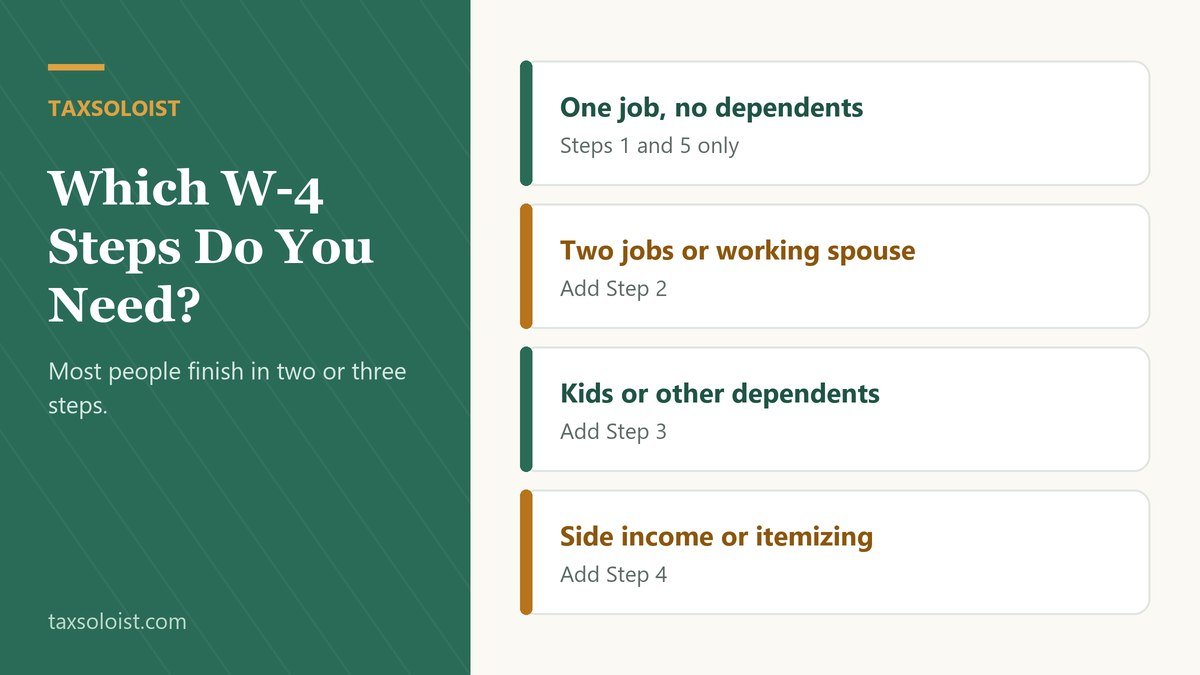
The Form W-4 looks like a five-step form, but nobody fills all five. Which steps you need depends on your life: one job or several, a spouse who works, children, income that has no withholding. Start with the table, then read only the sections that apply to you. Everything below follows the 2026 form published by the IRS.
Find your situation
| Your situation | Steps to complete | What to watch |
|---|---|---|
| One job, no dependents, no other income | 1 and 5 | Check the right filing status in Step 1(c). |
| Two jobs, or you and your spouse both work | 1, 2, 5, and 3-4 on one job only | Choose one of the three options in Step 2. |
| You have qualifying children or other dependents | 1, 3, 5 (plus 2 if two incomes) | Claim Step 3 on only one job. |
| Freelance or side income without withholding | 1, 4(a) or 4(c), 5 | Or make estimated tax payments instead. |
| You itemize and expect large deductions | 1, 4(b), 5 | Use the Deductions Worksheet on page 4. |
| No tax last year and none expected this year | 1, exemption, 5 | You must resubmit a new form for 2027. |
Step 1: your personal details
Enter your name, address, Social Security number and filing status: single or married filing separately, married filing jointly (or qualifying surviving spouse), or head of household. Your filing status sets the withholding tables your employer uses, so pick the one you will use on your return. The form also has a box for people who want to claim exempt status, covered below.
Step 2: two jobs or a working spouse
Withholding assumes each job is your only job, so two paychecks together are under-withheld. The 2026 form gives three ways to fix that:
- The IRS Tax Withholding Estimator (2(a)). Most accurate, and the best choice if you or your spouse have self-employment income.
- The Multiple Jobs Worksheet (2(b)). A paper worksheet on page 3. Enter the result in Step 4(c) of the form for the highest-paying job.
- The checkbox (2(c)). Only when there are just two jobs in total. Both employers must have it checked. The IRS says it is more accurate than the worksheet if the lower-paying job pays more than half of what the higher-paying job pays; otherwise use the worksheet.
Whatever you choose, complete Steps 3 through 4(b) on only one of the forms, ideally the highest-paying job, and leave them blank on the others. Claiming the same child twice is the most common reason a couple ends up owing at tax time.
Step 3: children and other dependents
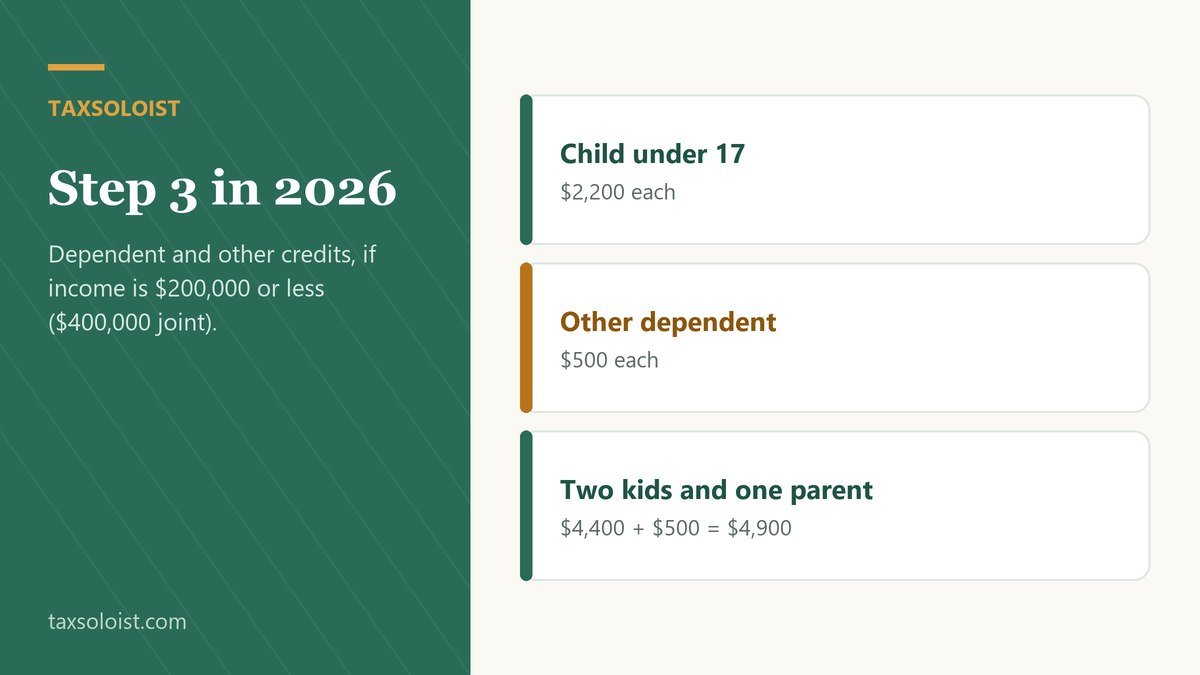
If your total income will be $200,000 or less ($400,000 or less if married filing jointly), multiply the number of qualifying children under 17 by $2,200 and the number of other dependents by $500, then add the two results. A worked example: a couple with two children under 17 and one dependent parent claims 2 × $2,200 = $4,400 plus 1 × $500 = $500, so $4,900 on line 3. Claim it on one of the two W-4s only. The Child Tax Credit rules behind this are covered in our Child Tax Credit guide.
Step 4: adjustments
- 4(a) Other income. Interest, dividends or retirement income you want tax withheld on. This does not include self-employment income if you pay estimated taxes.
- 4(b) Deductions. If you leave this blank, withholding is based on the standard deduction. Fill the Deductions Worksheet only if your itemized deductions and other adjustments will be higher than the standard deduction.
- 4(c) Extra withholding. A dollar amount added to every paycheck. This is the simplest lever when you know you will owe, for example because of freelance income.
Step 5: sign and give it to your employer
Sign and date the form and hand it to your employer or payroll system. Do not send it to the IRS. Your employer applies it from the next payroll period.
Exempt from withholding
You can claim exemption only if you had no federal income tax liability in the previous year and expect none this year. An exemption applies to one year: the 2026 form says you must submit a new Form W-4 for 2027 to continue. Exempt status stops federal income tax withholding, not Social Security or Medicare withholding.
When to submit a new W-4
Update your form after a marriage or divorce, a new child, a second job, a big raise, or when your refund or balance due last year was larger than you want. Run the IRS Tax Withholding Estimator with a recent pay stub, and if you also have 1099 income, compare the result with your estimated quarterly payments. You can submit a new W-4 at any time; there is no limit on how often.
Common mistakes that cause a surprise bill
- Completing Step 3 on both spouses’ forms. The children are claimed twice and withholding is too low. Put them on one form only.
- Ignoring a second job. Each employer withholds as if that job is your only income. Skipping Step 2 is the usual reason two-job households owe money.
- Forgetting self-employment income. A W-4 can add withholding, but self-employment tax is not withheld from your paycheck. Make estimated payments or add a dollar amount in Step 4(c).
- Using the exempt box when you owe tax. You can claim exemption only if you had no federal income tax liability last year and expect none this year.
- Never revisiting the form. A W-4 filled out years ago may no longer match your income, marriage or number of kids.
How your employer uses the form
Your employer’s payroll system reads your W-4 to decide how much federal income tax to withhold from each paycheck. It does not decide your actual tax; that is calculated on your return. If your W-4 says to withhold less than you will owe, you pay the difference when you file. If it says to withhold more, you get the difference back as a refund. Think of withholding as a prepayment, not the final bill.
Employers must act on a correctly completed W-4 and cannot change the numbers you wrote. They cannot give you tax advice either, so your payroll department can tell you how to submit the form but not what to put on it.
A quick method to check your withholding
- Gather your most recent pay stub and last year’s tax return.
- Open the IRS Tax Withholding Estimator and enter your income, filing status, credits and the federal tax withheld so far this year.
- The tool shows whether you are on track for a refund or a balance due and suggests what to enter on a new W-4.
- Submit the updated form to your employer. The earlier in the year you do it, the more paychecks share the adjustment.
If you also have income from freelancing, use the estimator’s options for self-employment income or compare the result with the amounts from our take-home pay calculator and your quarterly estimates.
Frequently asked questions
Can I claim zero allowances like the old form?
No. Since 2020 the W-4 no longer uses allowances. The form asks for dollar amounts in steps 3 and 4 instead.
Does the W-4 affect my state tax?
The federal W-4 covers federal income tax only. Many states have their own withholding form or use the federal one; your state revenue department can tell you which.
Should I aim for a big refund?
A large refund means you lent the government money for the year without interest. A small refund or a small balance due means your withholding is close to your real tax. The right target is the one that avoids a penalty and fits your budget.
Related guides
- How to Calculate Quarterly Estimated Taxes
- Withholding When Married and Self-Employed
- Take-Home Pay Calculator
- Standard Deduction Guide