
✅ Current for tax year 2026
A tax bill you cannot pay in full today is not a crisis if you act early. The IRS offers payment plans for exactly this, and applying costs far less than ignoring the balance. What follows is a side-by-side comparison, a cost example, and a checklist for choosing. All fees and limits are from the IRS payment plan page.
The options compared
| Option | Who qualifies | Time you get | Setup fee |
|---|---|---|---|
| Pay in full | Anyone | Immediately | None (card payments carry processing fees) |
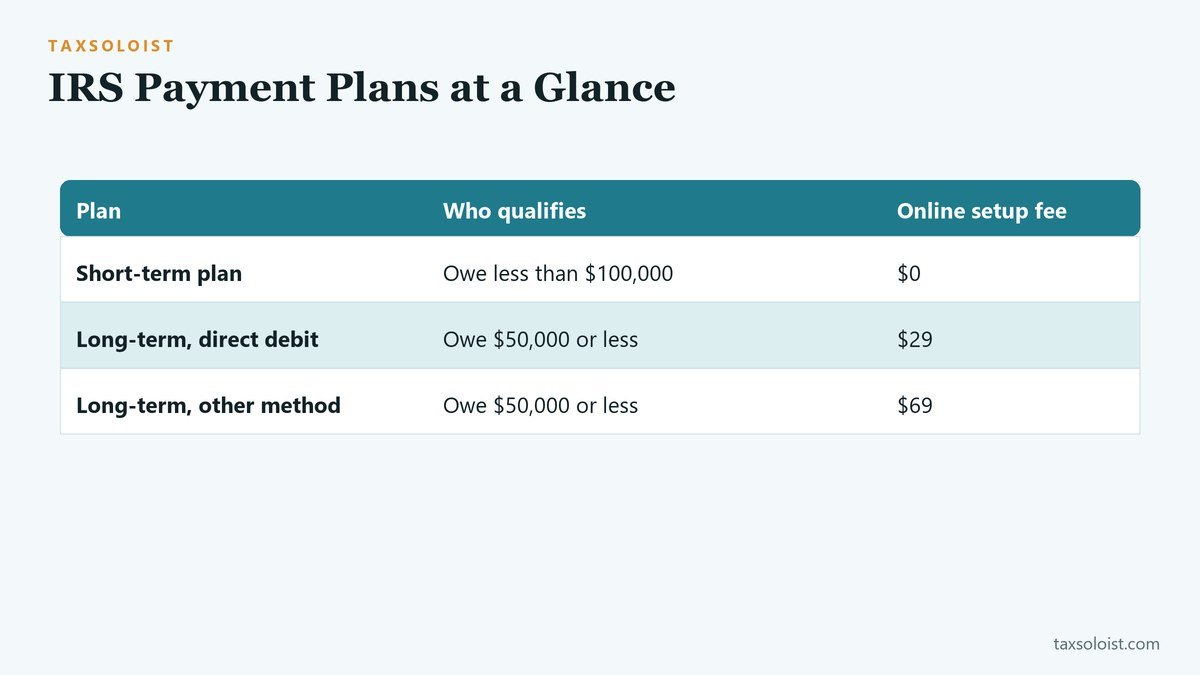
| Short-term payment plan | Owe less than $100,000 in combined tax, penalties and interest | Up to 180 days | $0, online or by phone, mail or in person |
| Long-term plan with direct debit (DDIA) | Owe $50,000 or less in combined tax, penalties and interest, and filed all required returns | Monthly payments, up to the collection period | $29 online; $107 by phone, mail or in person; waived for low-income applicants |
| Long-term plan, other payment method | Same as above | Monthly payments | $69 online; $178 by phone, mail or in person; $43 for low-income applicants (may be reimbursed) |
The pattern to notice: choosing direct debit and applying online is the cheapest long-term route. Only individuals can apply online for a short-term plan.
What a plan really costs
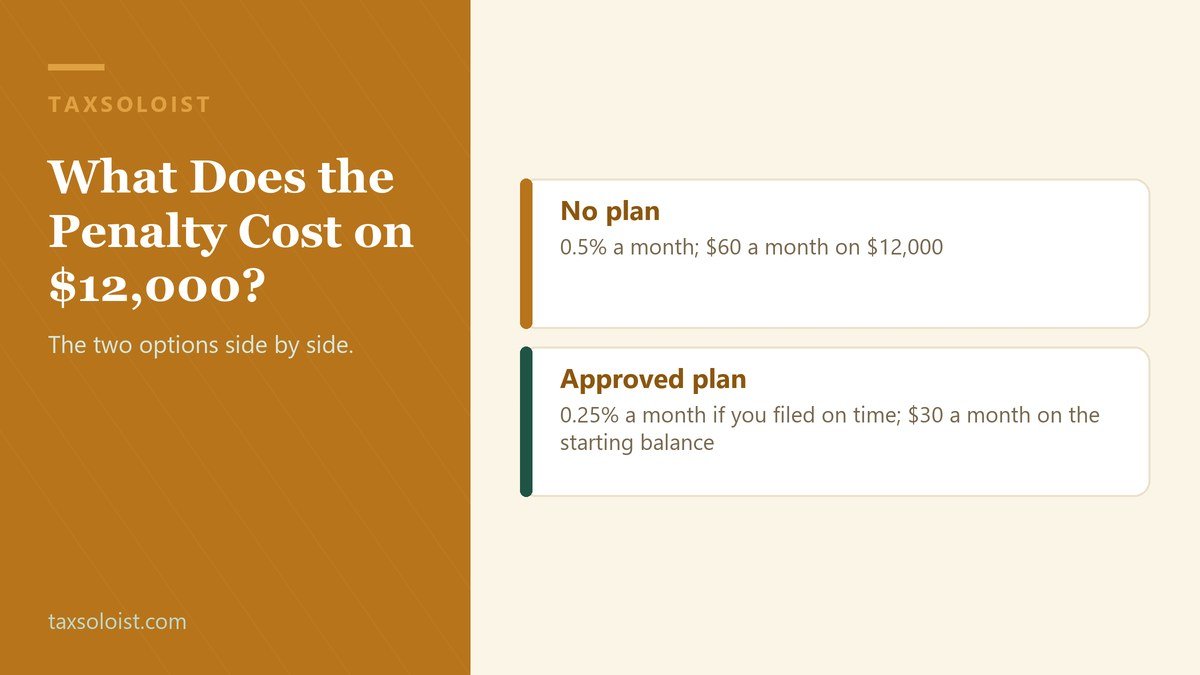
A payment plan is not a discount. Interest continues until the balance is gone, and the failure-to-pay penalty continues too, although at a lower rate during an approved plan if you filed your return on time (0.25% per month instead of 0.5%).
Example: a $12,000 balance
- Failure-to-pay penalty without a plan: 0.5% × $12,000 = $60 a month, up to 25% of the unpaid tax.
- During an approved plan: 0.25% × $12,000 = $30 a month on the starting balance, falling as you pay it down.
- Setup fee for a DDIA applied online: $29.
- Interest: set by the IRS each quarter and charged on top of the tax and penalties. The current rate is on the IRS interest page.
These numbers show why paying in full as soon as you can still wins: every month on the plan carries a charge. A plan makes sense when the alternative is a credit card with a higher interest rate, or no payment at all.
Short-term or long-term?
- Choose short-term if you can clear the whole balance within 180 days, for example from an expected bonus or a client payment. There is no setup fee, though penalties and interest still accrue.
- Choose long-term if you need more time and your balance fits under the limit. Set it on direct debit so the payment comes out automatically.
- Owe more than $50,000? You can still request an installment agreement, but you may need to apply by phone or mail and provide financial information.
Checklist before you apply
- File every required return, even if you cannot pay. A plan requires that your returns are filed.
- Know your balance, from your IRS online account, a notice or your return.
- Decide on a monthly amount you can keep up for the entire plan. The IRS says to pay at least the minimum when it is due, because missing payments can end the agreement.
- Have your bank routing and account numbers ready if you pick direct debit.
- Apply through the IRS Online Payment Agreement application, or by phone or mail if you do not qualify online.
- Keep making your estimated tax payments for the current year. Unpaid current-year tax creates a new balance. See how to calculate them.
Changing a plan later
You can change the payment amount or due date of an existing plan. Revising online costs $6; revising by phone, mail or in person costs $89; changes to an existing direct debit agreement are free. Low-income taxpayers pay less. If you default, the IRS can end the agreement and resume collection, so contact the IRS before you miss a payment, not after.
The penalties themselves are explained in our guide to late filing and late payment penalties.
If you cannot keep up with the plan
Missing a payment can put your agreement in default. Before that happens, call the number on your IRS notice or use your online account to ask for a change. The IRS says to make at least the minimum payment when it is due. If your situation gets worse, the IRS has other relief options, such as an offer in compromise (settling for less than you owe, under strict conditions) or temporarily delaying collection if paying would cause financial hardship. Both require financial disclosures and are decided case by case, so do not assume you will qualify.
Other ways to cover a tax bill
- Savings or a short-term loan. Compare the interest rate with the IRS rate plus penalties.
- Credit card. Paying by card avoids IRS penalties going forward, but the card’s interest rate may be higher than the IRS rate and card payments carry processing fees.
- Withholding or estimated payments for next year. Fixing next year’s payments prevents a repeat bill. See how to calculate quarterly estimated taxes.
Avoid these scams and mistakes
- The IRS does not demand payment by gift card, wire transfer or cryptocurrency, and it does not call out of the blue to threaten arrest. Pay only through IRS.gov, your bank’s direct pay to the IRS, or by check to the address on your notice.
- Companies advertising to “settle your tax debt for pennies” may charge high fees for an outcome you can apply for yourself.
- Do not stop paying current-year tax while you pay old tax; new unpaid tax can put the plan at risk.
Frequently asked questions
Do I have to pay anything to apply?
The short-term plan has no setup fee. Long-term plans have the fees in the table above, and low-income taxpayers pay less or nothing if they use direct debit.
Does a payment plan stop IRS collection?
While an agreement is pending or in effect, the IRS generally holds off on enforced collection, but interest and penalties continue. Keep up with every payment to keep that protection.
Can I pay more than the monthly amount?
Yes. Paying extra or paying the balance in full early reduces the penalties and interest you pay.
Related guides
- IRS Late Filing and Late Payment Penalties
- How to Calculate Quarterly Estimated Taxes
- How to File Taxes as an Independent Contractor