

✅ Current for tax year 2026
The Child Tax Credit (CTC) is one of the largest credits on a family return, and for 2026 it is worth up to $2,200 for each qualifying child. The credit reduces your tax dollar for dollar, and part of it can come back as a refund even if you owe no tax. Here is what decides whether you get it, and how much.
The amounts for 2026
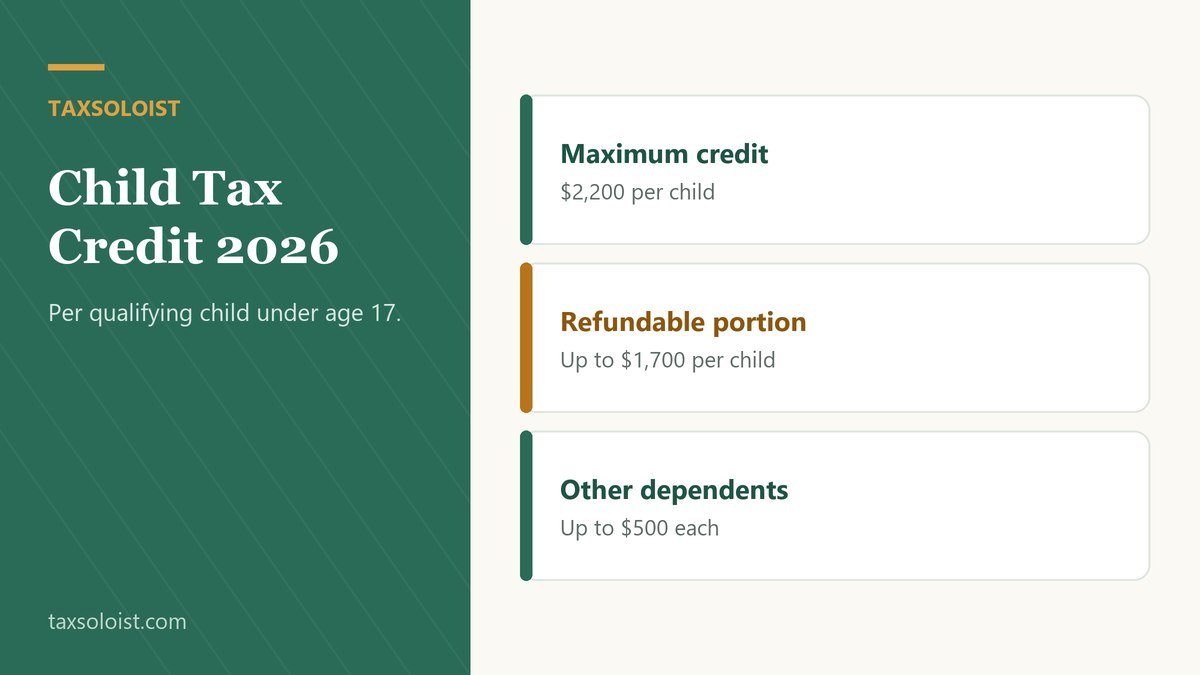
- Credit per qualifying child: up to $2,200 (IRS Rev. Proc. 2025-32).
- Refundable part: up to $1,700 per child, called the Additional Child Tax Credit (ACTC). You need at least $2,500 of earned income to claim it.
- Credit for other dependents: up to $500 for each dependent who is not a qualifying child, such as an older child or a parent you support. It is not refundable.
The qualifying-child tests
A child must pass every test. This table lists each one with the trap people fall into.
| Test | Rule | Common trap |
|---|---|---|
| Age | Under 17 at the end of the tax year | A child who turns 17 on December 31 does not qualify for that year. |
| Relationship | Your child, stepchild, foster child, sibling, or a descendant of one of them | Nieces and nephews qualify only if they fit the other tests. |
| Support | The child did not provide more than half of their own support | A teen with a job can fail this test. |
| Dependent | You claim the child as your dependent | Only one person can claim the same child. |
| Residency | Lived with you for more than half the year | Special rules apply for divorced or separated parents. |
| Citizenship | U.S. citizen, national or resident alien | Check the child’s status, not just the parents’. |
| Social Security number | A valid SSN for employment, issued before the return due date (with extensions) | An ITIN does not qualify a child for the $2,200 credit; it may qualify for the $500 credit. |
You (and your spouse, if filing jointly) must also have a Social Security number valid for employment that was issued before the due date of the return, including extensions.
How the phase-out works
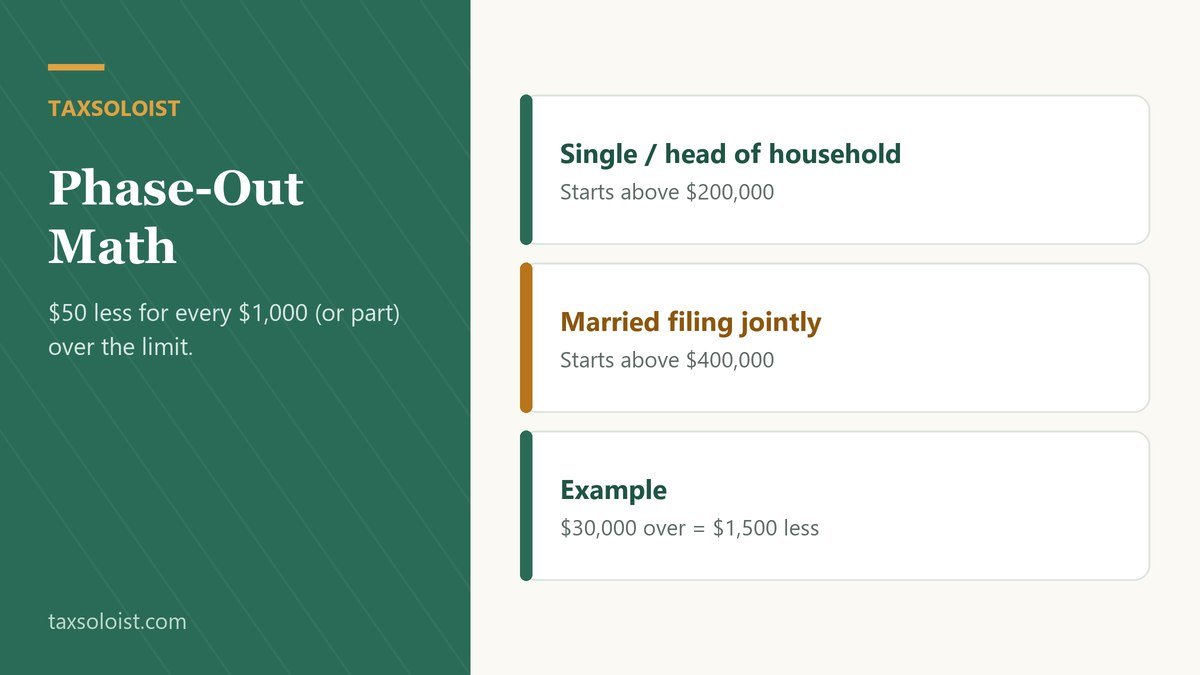
You receive the full credit if your income is not more than $200,000 ($400,000 if filing jointly). Above that, the credit shrinks by $50 for each $1,000, or part of $1,000, over the limit.
Example 1: joint filers, two children, $430,000 income
Full credit: 2 × $2,200 = $4,400. Income is $30,000 over $400,000, which is 30 steps of $1,000. Reduction: 30 × $50 = $1,500. Credit: $2,900.
Example 2: single parent, one child, $215,000 income
Income is $15,000 over $200,000, so the reduction is 15 × $50 = $750. Credit: $2,200 − $750 = $1,450.
The refundable part: Additional Child Tax Credit
If the credit is larger than the tax you owe, the unused amount can be refunded up to $1,700 per child, limited to 15% of your earned income above $2,500.
Example 3: single parent, two children, $20,000 of earned income, no income tax owed
Earned income above $2,500 is $17,500, and 15% of that is $2,625. The per-child cap is 2 × $1,700 = $3,400, so the refundable credit is the smaller figure: $2,625. If you also owe some income tax, the credit first reduces that tax and the refundable part covers the rest.
How to claim it
- List each child with the correct SSN on Form 1040. A typo or a missing number is the most common reason the IRS removes the credit.
- Complete Schedule 8812 if you claim the credit; it calculates the credit and the refundable part.
- Match your W-4 to your credit so the money arrives in your paycheck rather than at refund time. Step 3 of the 2026 Form W-4 uses the same $2,200 and $500 amounts.
The IRS notes that it cannot issue refunds that include the Additional Child Tax Credit or the Earned Income Tax Credit before mid-February. That applies to your whole refund, not just the credit part.
If you are self-employed
Self-employment income counts as earned income for the ACTC, but the credit depends on your adjusted gross income for the phase-out. Business deductions that lower your AGI can help keep you under the limit. State credits for children are separate, and many states have their own.
Special situations
Divorced or separated parents
The parent the child lived with for more of the year (the custodial parent) normally claims the child. The custodial parent can release the claim to the other parent by signing Form 8332, which the other parent attaches to their return. Only one parent can claim a given child in a year.
A child born during the year
A baby born at any time during the tax year can qualify for the whole year’s credit, as long as the other tests are met and the baby has a Social Security number. If the baby is born on December 31, the credit is still available for that year.
Children without a Social Security number
A child who has an ITIN instead of an SSN does not qualify for the $2,200 credit but may qualify as an “other dependent” for the $500 credit. Applying for the SSN early can matter, since the number must have been issued before the return due date (with extensions).
Student children and adult dependents
A child who is 17 or older at year end does not qualify for the Child Tax Credit, including a full-time student, but may qualify for the $500 credit for other dependents and for education credits.
Mistakes that lead to IRS letters
- Entering a name or Social Security number that does not match the Social Security card.
- Both parents (or a parent and a grandparent) claiming the same child.
- Claiming a child who did not live with you for more than half the year.
- Using the wrong tax year to compute the child’s age: age is measured at the end of the tax year.
If the IRS disallows the credit and you disagree, you can respond with records such as school, medical or lease documents showing where the child lived. Keep these papers with your return.
Frequently asked questions
Is the credit paid monthly in 2026?
No. The advance monthly payments of 2021 were a one-year change. The credit is claimed on your return, and you can adjust your paycheck withholding to receive the benefit earlier through the W-4.
Does the credit reduce my income?
It reduces your tax, not your income. A $2,200 credit lowers your tax bill by $2,200 whether your bracket is 12% or 24%, which makes it more valuable than a $2,200 deduction.
Does the credit apply to my state return?
The federal credit has no effect on your state tax. Some states have their own child credits with separate rules, so check your state revenue agency.
Related guides
- How to Fill Out Form W-4 for 2026
- Standard Deduction Guide
- AGI for the Self-Employed
- Effective vs. Marginal Tax Rate