
✅ Current for tax year 2026
Quick answer: often, yes — because whoever paid you may have already told the IRS. If a client, platform, or payment app files a 1099 in your name and the income doesn’t show up on your return, an automated system is likely to flag it, sometimes a year or more later.
How the mismatch actually gets caught
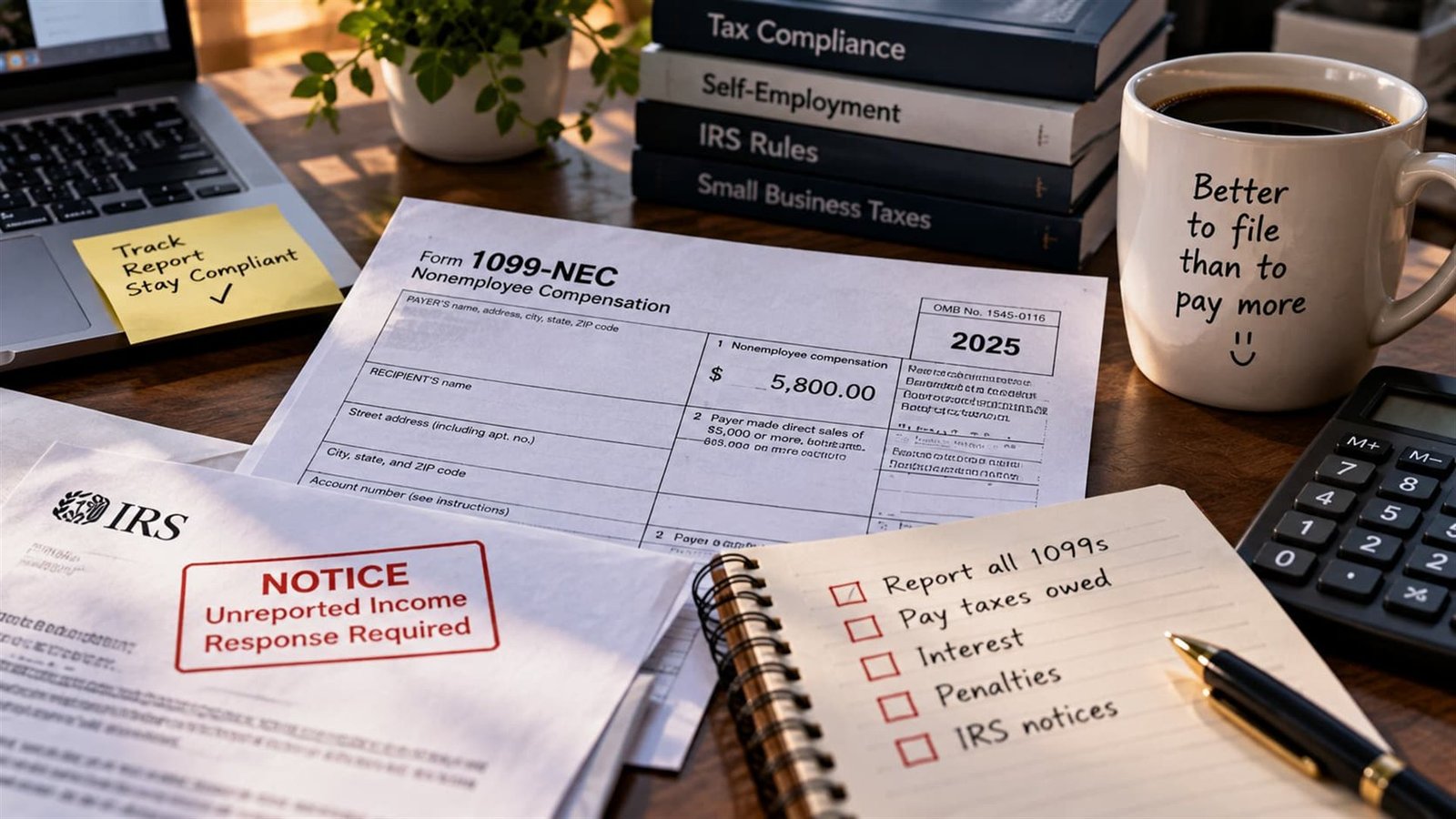
Businesses and platforms that pay you file a copy of your 1099 with the IRS, not just with you. The IRS’s Automated Underreporter (AUR) program cross-checks the income reported on your return against everything filed under your Social Security number. When there’s a gap, it generates a notice — commonly a CP2000 — proposing additional tax, interest, and sometimes a penalty, based on the difference.

Why this can take a while
This matching doesn’t happen instantly. It’s common for a CP2000 notice to arrive twelve to eighteen months after you filed, once the IRS has processed and cross-referenced that year’s forms. That delay is exactly why “nothing happened yet” doesn’t mean nothing will.
What if the payer never sent you a 1099 at all?
You’re still required to report the income. Many payers only issue a 1099-NEC or 1099-K once you cross a specific threshold — but your obligation to report self-employment income doesn’t have a minimum. Small, scattered payments with no form attached are exactly the kind of income people assume is invisible, and they’re not necessarily wrong that it’s less likely to be flagged automatically — but “less likely to get caught” and “not owed” are different things.
If you already missed reporting something
The standard fix is an amended return (Form 1040-X) for the year in question, filed before the IRS catches it if possible — voluntarily correcting a mistake is treated very differently from getting caught. Interest accrues either way, but proactively fixing it generally limits how much worse the situation gets.
Keep your own running total
The most reliable way to avoid a surprise notice is to track every 1099-NEC, 1099-K, and any unreported cash income yourself over the year, rather than waiting for forms to arrive in January. Once you have a real total, the 1099 & quarterly tax calculator shows what you should be setting aside.
What a CP2000 notice actually asks for
A CP2000 isn’t a bill and it isn’t an audit notice — it’s a proposed adjustment based on a mismatch the IRS’s system found automatically. It lists the income it believes you didn’t report, the source (the payer’s name and the form type), and a calculated additional tax, interest, and sometimes a penalty. You have three real options: agree and pay, partially agree, or disagree with documentation showing the income was already reported elsewhere or doesn’t belong to you. Responding by the deadline on the notice (usually 30 days) matters — ignoring a CP2000 lets the IRS assess the proposed amount automatically, which is much harder to unwind than responding on time.
What it actually costs to be late
Interest accrues from the original filing deadline, not from when the notice arrives — so an eighteen-month gap between filing and the notice means eighteen months of accrued interest already. A common accuracy-related penalty adds 20% of the underpayment on top of that. Filing an amended return voluntarily, before a notice arrives, generally avoids the accuracy penalty entirely — interest still applies, but that’s a meaningfully better outcome than waiting to get caught.
The difference between a mistake and willful evasion
The IRS treats an honest oversight very differently from deliberate underreporting, and the distinction matters for what penalties apply. A missed 1099 because you genuinely forgot, lost the form, or made a math error is typically handled through the standard CP2000 process described above — additional tax, interest, and a possible accuracy-related penalty. Willful, intentional failure to report income you knew about is a different category entirely, potentially involving fraud penalties that are substantially higher, and in rare, extreme, repeated cases, criminal referral. The overwhelming majority of missed-1099 situations fall into the first category, not the second — but the IRS does look at patterns. A single missed form one year reads very differently from the same income source going unreported for several consecutive years.
Should you hire help for a CP2000 response?
A straightforward CP2000 where you agree the income was missed and the math is simple is usually manageable to handle yourself — the notice includes clear instructions for how to respond. Where professional help earns its cost: if you disagree with the IRS’s figures, if multiple years or multiple mismatches are involved, or if the proposed amount is large enough that a mistake in your response could be costly. An enrolled agent or CPA can often resolve a complex mismatch faster and more accurately than navigating it alone, and their fee is frequently smaller than the difference between a well-handled response and a rushed one.
Related guides
- Married Filing Jointly Tax Guide: How to Handle Withholding When One Spouse Is Self-Employed
- Schedule C, Line by Line: The Freelancer’s Walkthrough
- Can Gig Workers Claim the QBI Deduction Without an LLC or Sole Proprietorship?
- What Counts Toward Your AGI When You’re Self-Employed
- California Self-Employment Tax: What You Owe at the Federal and State Level
- Do You Pay Self-Employment Tax on Rental Income?
- StubHub, Sneakers, and Marketplace Flips: When Reselling Becomes Taxable Income
Sources
Matching-notice process based on the IRS’s Automated Underreporter program; see Understanding Your CP2000 Series Notice on IRS.gov. This is general information, not tax advice.