

✅ Current for tax year 2026
Quick answer: If you are self-employed, you may be able to deduct the premiums you pay for health insurance for yourself, your spouse and your dependents, using Form 7206. The IRS says the insurance includes medical, dental and vision insurance and qualified long-term care insurance, and can also cover your child who was under age 27 at the end of the year, even if the child was not your dependent. The deduction goes on Schedule 1 (Form 1040), line 17, and is limited by your net profit from the business under which the plan is established, and it is not allowed for any month you were eligible for a subsidized employer plan, including your spouse’s. It lowers your income tax but not your self-employment tax.
In this guide
- Who qualifies
- The plan must be established under your business
- Which premiums count and which do not
- The profit limit
- Where it goes and what it does not do
- Worked example 1: the full deduction
- Worked example 2: limited by profit
- Worked example 3: a spouse with an employer plan
- Estimate your health insurance deduction limit
- S corporation owners and partners
- Common questions
- Key takeaways
- Sources
Who qualifies
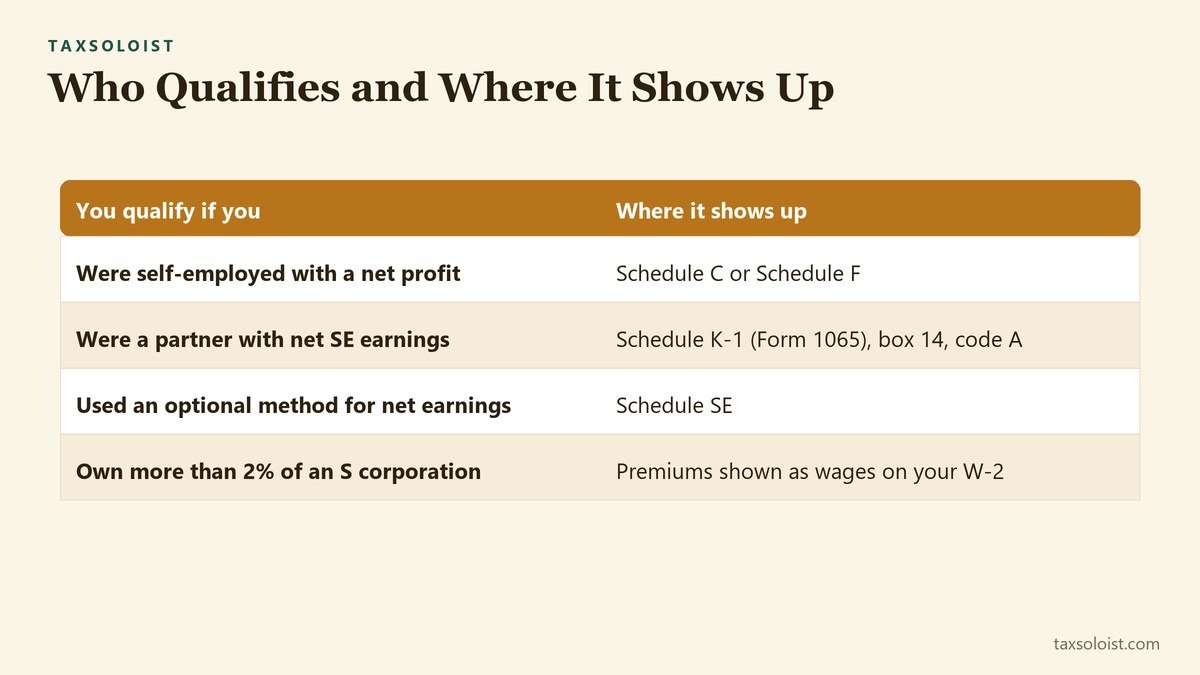
The Form 7206 instructions say that one of the following must be true:
| You qualify if you… | Where it shows up |
|---|---|
| Were self-employed with a net profit for the year | Schedule C or Schedule F |
| Were a partner with net earnings from self-employment | Schedule K-1 (Form 1065), box 14, code A |
| Used one of the optional methods to figure net earnings | Schedule SE (see the optional methods guide) |
| Received wages from an S corporation in which you own more than 2% | Premiums paid or reimbursed by the corporation are shown as wages on your W-2 |
A loss does not qualify you: without net profit the deduction is zero, unless one of the other situations applies.
The plan must be established under your business
For a sole proprietor filing Schedule C or Schedule F, the policy can be in the name of the business or in your own name. For partners, it can be in the name of the partnership or the partner, but if you pay it yourself the partnership must reimburse you and report the premiums as guaranteed payments. For more-than-2% S corporation shareholders, the policy can be in the corporation’s name or yours, but if you pay the premiums yourself the corporation must reimburse you and report them in box 1 of your W-2. Medicare premiums you voluntarily pay to get insurance in your own name that is similar to qualifying private health insurance can be used to figure the deduction. See S corp tax write-offs for the S corporation mechanics.
Which premiums count and which do not
- Medical, dental and vision insurance premiums for you, your spouse and your dependents.
- Qualified long-term care insurance, up to an age-based limit per person. The 2025 form limits are $480 (age 40 or younger), $900 (41 to 50), $1,800 (51 to 60), $4,810 (61 to 70) and $6,020 (71 or older); the amounts change each year, so check the form for your year.
- Not included: amounts for any month you were eligible to participate in a health plan subsidized by your employer or your spouse’s employer (or that of your dependent or your child under 27); and certain amounts paid by a retired public safety officer’s plan.
The IRS says you cannot take the deduction for any month you were eligible to participate in an employer (including your spouse’s) subsidized health plan at any time during that month, even if you did not actually participate. The rules are applied separately to plans that provide long-term care insurance and plans that do not. The premium for a stand-alone dental plan is a premium for health insurance for this purpose; see self-employed dental insurance.
The profit limit
Form 7206 limits the deduction to your net profit (and other earned income) from the business under which the plan is established, reduced by the deductible part of self-employment tax allocated to that business and by contributions for yourself to a SEP, SIMPLE or qualified plan from the same business. In other words, you cannot create a loss from the deduction. If you have more than one business and more than one plan, use a separate Form 7206 for each plan, and the form is required if you had more than one source of self-employment income, use Form 2555, or use qualified long-term care premiums. Otherwise the worksheet in the Form 1040 instructions may be used. If you buy insurance through the Marketplace and claim the premium tax credit, see Publication 974, because the credit and the deduction depend on each other.
Where it goes and what it does not do
- Enter it on Schedule 1 (Form 1040), line 17. It reduces adjusted gross income, so it is an adjustment to income, not a Schedule C expense and not an itemized deduction.
- Do not include the amount in your medical expense deduction on Schedule A, according to the instructions.
- It does not reduce self-employment tax: the IRS says you cannot subtract it when figuring net earnings for self-employment tax from that business.
Because it reduces AGI, it can help with other AGI-based limits; see AGI for the self-employed. Choosing a plan is a separate decision; see affordable health insurance for the self-employed.
Worked example 1: the full deduction
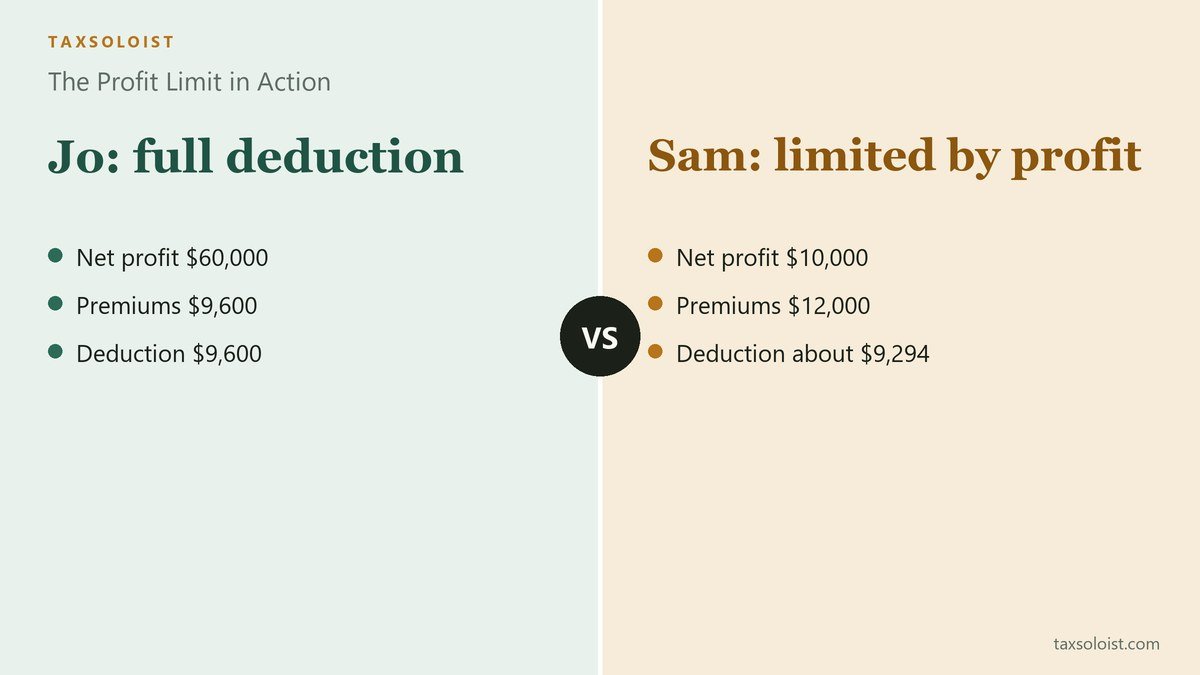
Jo is a single freelancer with $60,000 of net profit and pays $9,600 in premiums for the year. Jo also contributes $5,000 to a SEP IRA.
- Self-employment tax: $60,000 times 92.35% times 15.3% is about $8,478; half is about $4,239.
- Limit: $60,000 minus $4,239 minus $5,000 is about $50,761.
- Deduction: the smaller of premiums ($9,600) and the limit: $9,600.
At a 22% bracket the deduction saves about $2,112 of income tax. It does not change the self-employment tax. If Jo had been in the 12% bracket it would save about $1,152.
Worked example 2: limited by profit
Sam’s business earned $10,000 and Sam paid $12,000 of premiums.
- Self-employment tax: $10,000 times 92.35% times 15.3% is about $1,413; half is about $706.
- Limit: $10,000 minus $706 is about $9,294.
- Deduction: about $9,294, not $12,000.
The rest of the premiums, about $2,706, is not part of this deduction. Ask a tax professional whether the balance can count as a medical expense on Schedule A, which has its own floor.
Worked example 3: a spouse with an employer plan
Pat is self-employed and buys a plan for $800 a month for the family. Pat’s spouse was eligible for a subsidized employer plan from January through April and then left that job.
- Months eligible for the employer plan: January through April, so the premiums for those four months do not count.
- Eligible months: May through December, 8 months times $800 is $6,400.
Eligibility for the employer plan is what matters, even if the spouse did not enroll. Pat then checks the profit limit and the premium tax credit rules before claiming the deduction.
| Jo: full deduction | Sam: limited by profit | Pat: employer plan months | |
|---|---|---|---|
| Net profit | $60,000 | $10,000 | — |
| Premiums paid | $9,600 | $12,000 | $800 a month |
| Limit (profit minus half of SE tax and plan contributions) | about $50,761 | about $9,294 | Months eligible for a spouse’s plan do not count (Jan to Apr) |
| Deduction | $9,600 | about $9,294 | $6,400 (8 months) |
Estimate your health insurance deduction limit
Enter your net profit, the premiums you paid for eligible months and any retirement plan contributions you made for yourself. The calculator applies the profit limit from Form 7206: net profit minus the deductible half of self-employment tax minus plan contributions. It does not check month-by-month eligibility for an employer plan.
This calculator needs JavaScript.
S corporation owners and partners
If you own more than 2% of an S corporation, the corporation must report the premiums in your W-2 box 1, and you take the deduction on your own return. The S corporation line of the form uses your Medicare wages (box 5) from that corporation as the limit. Partners who receive guaranteed payments for premiums can also claim it. Missing the W-2 reporting is the most common error and can disqualify the deduction; see the IRS page on S corporation compensation and medical insurance, and our S corp tax guide.
Common questions
Can I deduct premiums I pay for my children?
Yes, for your dependents and for a child who was under age 27 at the end of the year.
Can I deduct Medicare premiums?
Premiums you voluntarily pay to obtain insurance in your own name that is similar to qualifying private health insurance can be used, according to the instructions. Ask whether your Medicare parts qualify.
Does the deduction apply to a health sharing plan?
The IRS instructions describe health insurance. Ask a tax professional about other arrangements.
Do I need Form 7206?
Sometimes. The worksheet in the Form 1040 instructions is enough in the simple cases; use Form 7206 in the cases listed above.
Key takeaways
The self-employed health insurance deduction is one of the largest deductions available to freelancers with insurance premiums. It reduces income tax, not self-employment tax, and it is limited by net profit and by any month in which you could have joined a subsidized employer plan. Keep your premium statements, check the long-term care limits and use Form 7206 when it is required. This guide is based on the 2025 Form 7206 and its instructions; check the form for your tax year.
Related guides
- Self-Employment Tax Calculator
- Effective Tax Rate vs. Marginal Rate: How to Calculate Yours
- How to Calculate Quarterly Estimated Taxes for the Self-Employed
- AGI for the Self-Employed
- Tax Deduction Calculator
- Take-Home Pay Calculator
- Self-Employed Tax Deductions: The Complete List for 2026
- Social Security Tax for the Self-Employed
- Affordable Health Insurance for the Self-Employed
- Self-Employed Dental Insurance
- S Corp Tax Write-Offs
- HSA for the Self-Employed
- Solo 401(k) vs. SEP IRA
- Self-Employment Tax Optional Methods
- Disability Insurance for the Self-Employed: Short-Term vs. Long-Term, Cost, and Tax Treatment
- Medical Expense Deduction: What Counts, the 7.5% Floor, and Who Can Deduct Dental, Medicare Part B, and Special Diets