
✅ Current for tax year 2026
Short version: if you sell an investment you held for more than a year, the profit is a long-term capital gain and the 2026 federal rate is 0%, 15% or 20%, depending on your taxable income. If you held it a year or less, the profit is taxed like wages at your regular bracket. The thresholds below come straight from the IRS 2026 inflation adjustments.
The 2026 rate thresholds at a glance
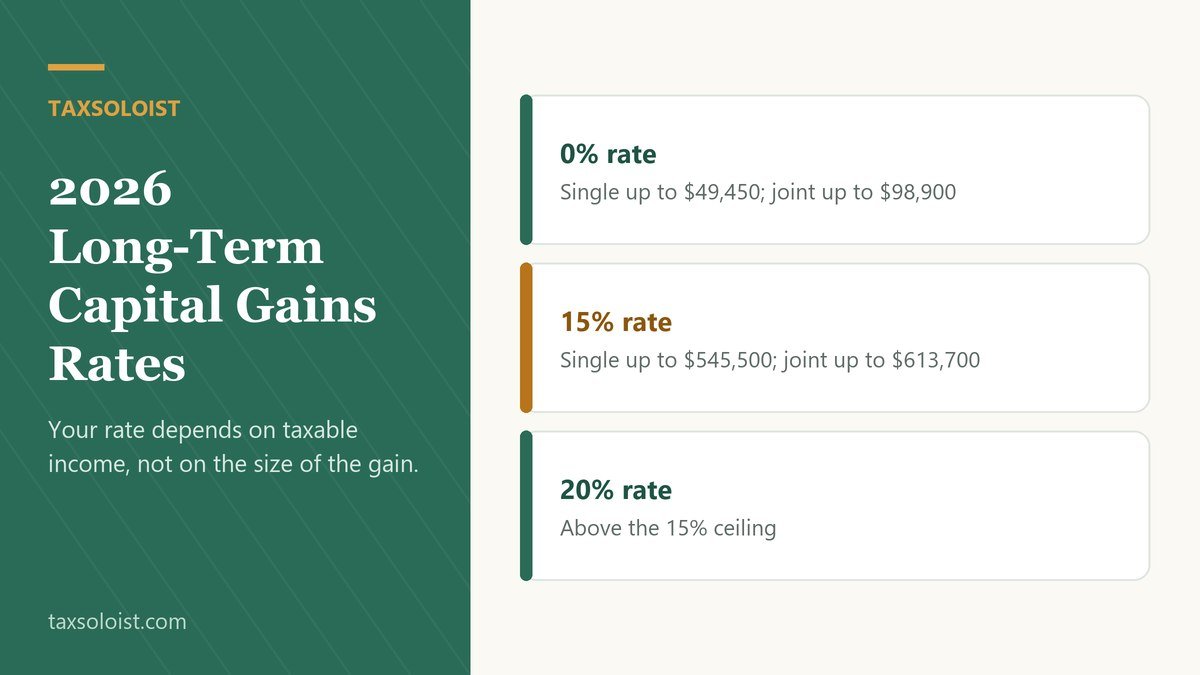
These amounts are taxable income (income after deductions), and they cover long-term gains and qualified dividends.
| Filing status | 0% up to | 15% up to | 20% above |
|---|---|---|---|
| Single | $49,450 | $545,500 | $545,500 |
| Married filing jointly / surviving spouse | $98,900 | $613,700 | $613,700 |
| Head of household | $66,200 | $579,600 | $579,600 |
| Married filing separately | $49,450 | $306,850 | $306,850 |
Two exceptions sit outside this table. Gains on collectibles such as art, coins and precious metals are taxed at up to 28%, and the part of a real estate gain that comes from depreciation you claimed (unrecaptured Section 1250 gain) is taxed at up to 25%.
Short-term or long-term: the holding period
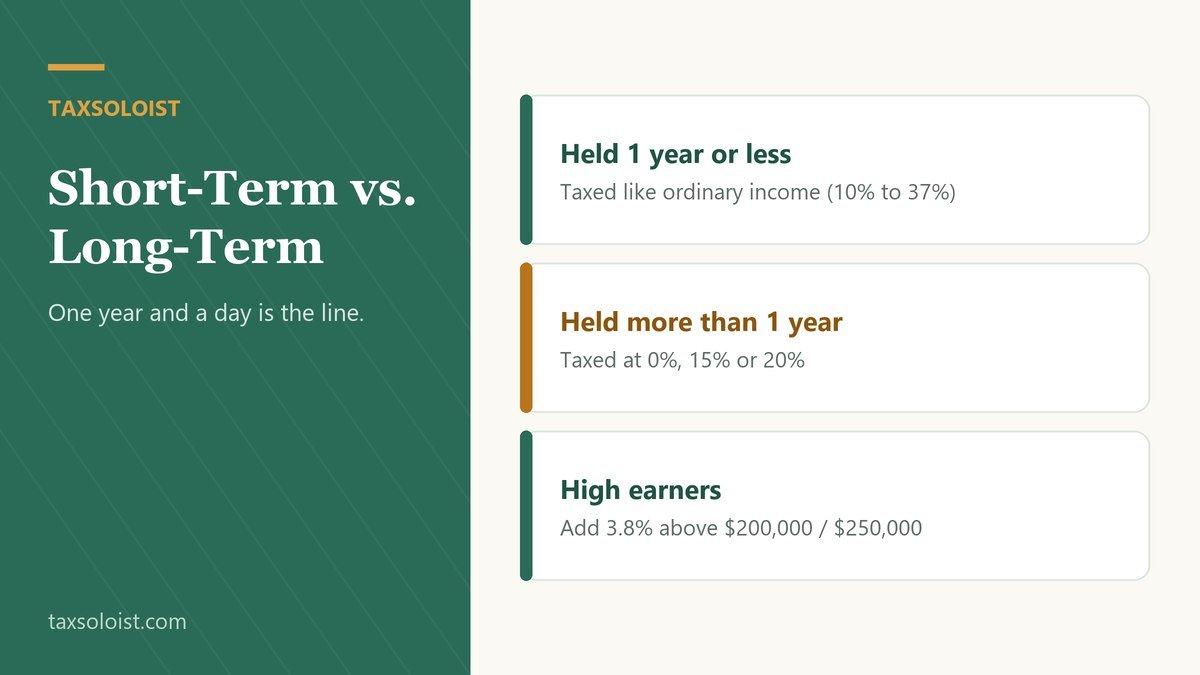
Count from the day after you acquire the asset to the day you sell it. You need more than one year. Selling after 365 days is still short-term; the long-term rate starts the day after the first anniversary. Short-term gains are added to your other income and taxed at your marginal bracket, so for a worker in the 24% bracket the same $10,000 gain costs $2,400 as short-term and $1,500 as long-term at the 15% rate. Waiting a few days can move a gain from one column to the other, which is why the date on the trade confirmation matters.
Your broker reports each sale on Form 1099-B and you list them on Form 8949, which feeds Schedule D. Losses first offset gains of the same type, then the other type. If losses beat gains, you can deduct up to $3,000 a year ($1,500 if married filing separately) against other income and carry the rest forward.
How gains stack on top of your income
Capital gains are not taxed by looking at the gain alone. Your ordinary taxable income fills the lowest brackets first, and the gain is stacked on top. The part of the gain that lands below the 0% line is tax-free, the next slice is taxed at 15%, and so on. A single gain can therefore be taxed at two rates. This is the reason a modest gain can be completely free of federal tax for someone with a small salary and quite expensive for someone with a large one.
Four worked examples (2026, standard deduction)
Example 1: single, $60,000 salary, $10,000 long-term gain
Taxable income before the gain is $60,000 minus the $16,100 standard deduction, or $43,900. The 0% rate runs up to $49,450, which leaves $5,550 of room. The first $5,550 of the gain is taxed at 0%, and the remaining $4,450 at 15%, or $667.50.
If the same $10,000 had been a short-term gain, it would sit on top of $43,900 in the ordinary brackets: $6,500 at 12% ($780) and $3,500 at 22% ($770), for $1,550. Holding past one year saves $882.50 here.
Example 2: married couple, $90,000 taxable income, $30,000 long-term gain
The 0% ceiling for joint filers is $98,900, so $8,900 of the gain is tax-free and the other $21,100 is taxed at 15%: $3,165.
Example 3: single, high income, $100,000 long-term gain
Assume $500,000 of ordinary taxable income. The 15% rate applies up to $545,500, so $45,500 of the gain is taxed at 15% ($6,825) and the remaining $54,500 at 20% ($10,900). That is $17,725. Because income is well above $200,000, the 3.8% net investment income tax also applies. If the $100,000 gain is the only investment income, that adds $3,800, for a federal total of $21,525 on the gain.
Example 4: using a loss
You sell one stock at a $12,000 gain and another at a $15,000 loss. The loss cancels the gain and leaves a $3,000 net loss, which you can deduct against ordinary income this year. Nothing is carried forward in this case, because the full $3,000 is used.
The 3.8% net investment income tax
The net investment income tax (NIIT) is a separate 3.8% tax on the lesser of your net investment income or the amount your modified adjusted gross income exceeds $200,000 (single or head of household), $250,000 (married filing jointly) or $125,000 (married filing separately). These thresholds are not adjusted for inflation. It applies to gains, interest, dividends and certain rental income, and it is reported on Form 8960.
Practical moves worth checking
- Check the 0% room before you sell. If your taxable income is low this year, a gain may fall entirely under the 0% line.
- Look at the holding date. If you are a few days short of one year, waiting can change the rate.
- Offset gains with losses from other positions before year end, keeping the wash-sale rule in mind.
- Add state tax. Most states tax capital gains as ordinary income, and a few have special rates.
Self-employed readers should note that capital gains do not count as net earnings from self-employment, so they are not subject to self-employment tax. For the ordinary-bracket side of the picture, see our guide to effective versus marginal rates.
Qualified dividends use the same rates
Qualified dividends are taxed at the same 0%, 15% and 20% rates as long-term gains, and they use the same taxable-income thresholds. To be “qualified”, a dividend must come from a U.S. corporation or a qualifying foreign one, and you must have held the stock for the required period around the ex-dividend date. Your broker reports the qualified part in box 1b of Form 1099-DIV. Dividends that are not qualified (ordinary dividends) are taxed like wages. Because dividends and gains share the same stacking space, a large dividend can use up the 0% room you were counting on for a sale.
Your cost basis decides the gain
The gain is the sale price minus your basis, which is what you paid plus commissions and fees. How you pick which shares you sold matters when you bought at different prices. Unless you tell your broker otherwise, many default to first-in, first-out, which sells your oldest (usually cheapest) shares first and creates the biggest gain. Specific identification lets you choose the shares with the highest basis or the ones you have held past one year, and can reduce the tax. Gifted and inherited assets have their own basis rules: an inherited asset generally takes a basis equal to its value at the date of death, and gifted assets generally carry over the giver’s basis.
Common questions
Do I owe tax on a gain if I reinvest the money?
Yes. Selling creates the taxable event even if you buy something else the same day. The only common ways to defer tax are retirement accounts, specific like-kind exchanges of real property, and the home sale exclusion.
Can I use a loss from a sale to a family member?
Not usually. The loss on a sale to a related person is disallowed, and the wash-sale rule disallows a loss if you buy the same or substantially identical security within 30 days before or after the sale.
How do estimated taxes work with a big gain?
Tax on a gain is not withheld, so a large sale can leave you with an underpayment penalty if you do nothing. Make an estimated payment for the quarter of the sale, or raise your withholding at work. Our guide to quarterly estimated taxes shows how.
Is crypto taxed the same way?
Crypto is treated as property, so selling or trading it creates a gain or loss with the same holding-period rules: a year or less is short-term, more than a year is long-term.
Related guides
- Effective vs. Marginal Tax Rate
- Standard Deduction Guide
- Taxes on Resale Flips and Marketplace Sales
- Taxes on Sports Betting Winnings