
✅ Current for tax year 2026
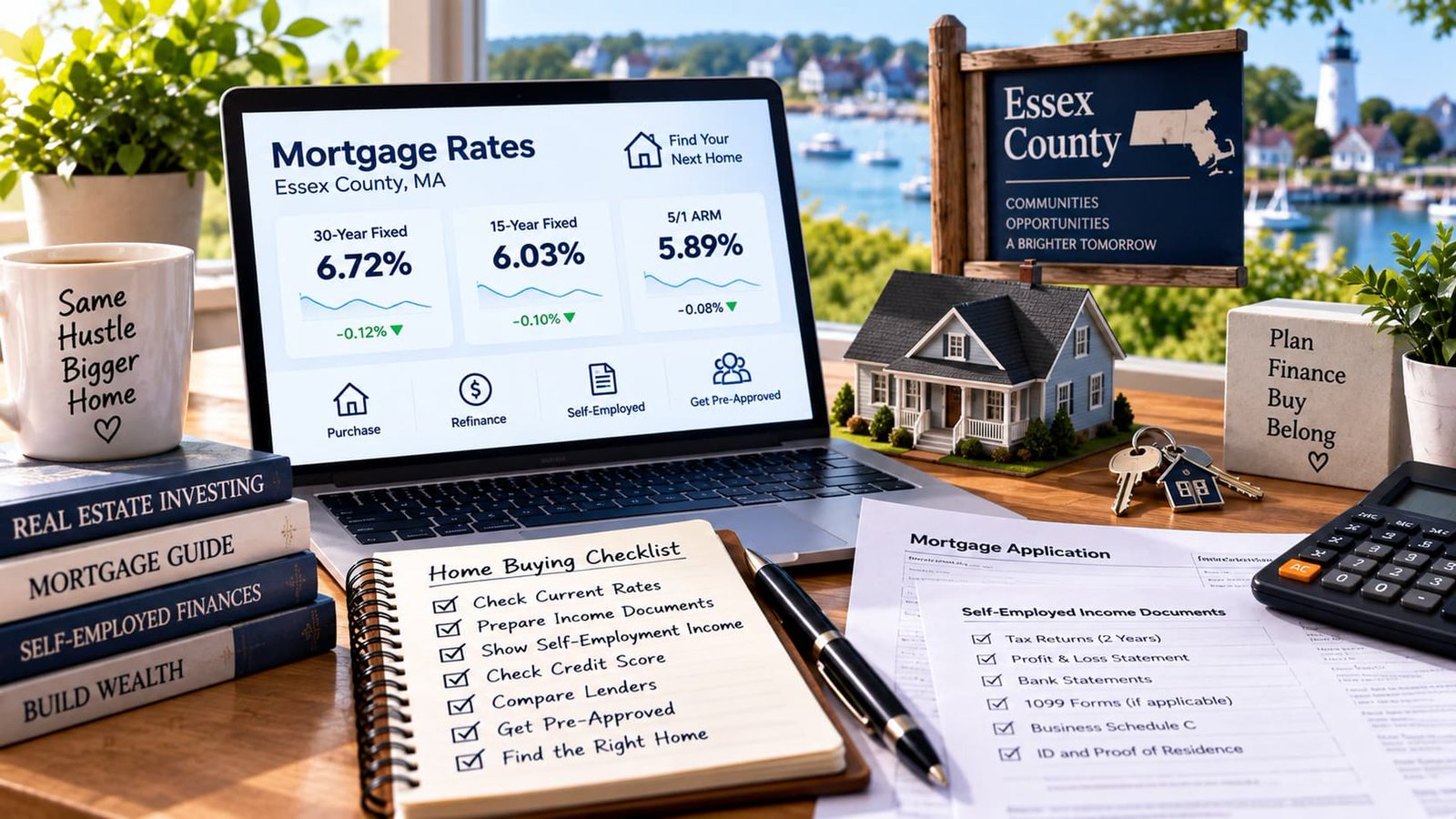
Quick answer: Mortgage rates change daily and aren’t specific to a county, so we won’t quote a static number here that would be stale within days — check a live source like Freddie Mac’s Primary Mortgage Market Survey or a local Essex County lender for today’s actual rate. What genuinely differs for self-employed borrowers isn’t the rate itself, but whether you can qualify at all — and that’s the part worth understanding in advance.
Why self-employed borrowers are underwritten differently
A W-2 borrower qualifies off a recent pay stub and a current salary. A self-employed borrower — including most 1099 gig workers, freelancers, and small business owners in Essex County — typically has to show two years of tax returns, and the lender averages the net profit from those two years’ Schedule C filings to arrive at “qualifying income.” A single strong year usually isn’t enough on its own, even if your most recent twelve months were genuinely stronger than the average suggests.
Why your own tax strategy can work against you
Here’s the tension few people warn you about: every legitimate deduction you claim on the complete deductions list lowers your tax bill, but it also lowers the net profit figure a mortgage lender will use to qualify you. A self-employed borrower who aggressively minimizes taxable income for two years in a row may end up with a lower mortgage-qualifying income than someone with the same actual cash flow who took fewer deductions. If a home purchase is on the horizon in the next year or two, it’s worth running your numbers through the Tax Deduction Calculator with that tradeoff in mind before you file.
Conventional underwriting vs. bank-statement loans
Once you clear the qualifying-income hurdle, the same factors that move anyone’s rate apply: credit score, down payment size, and debt-to-income (DTI) ratio matter far more locally than which Massachusetts county the property sits in. Loan type matters too — some self-employed borrowers who don’t fit conventional two-year-average underwriting instead use bank-statement loan programs, which qualify off deposit history rather than tax returns, typically at a rate premium in exchange for the flexibility. These programs can be a real solution for a business owner whose tax-optimized net profit doesn’t reflect actual cash flow, but they generally come with stricter down payment requirements and a higher rate than a conventional loan would offer the same borrower on paper.

A concrete illustration of the tradeoff
Consider two Essex County freelancers with identical $150,000 in actual annual deposits. One claims aggressive deductions and reports $70,000 in net Schedule C profit; the other claims fewer deductions and reports $110,000. Both paid different amounts in tax as a result, but for mortgage qualifying purposes, the second freelancer’s higher reported income generally supports a larger loan amount under standard conventional underwriting — even though their real cash flow may be similar once actual (not reported) expenses are considered. This is exactly why the decision isn’t purely about minimizing this year’s tax bill if a mortgage application is coming up soon.
Getting mortgage-ready as a 1099 earner
The practical steps: keep two consecutive years of consistent Schedule C filing (a business structure change reset can complicate this — see Sole Proprietorship vs. Independent Contractor before making entity changes close to a home purchase), keep your DTI ratio manageable, and use the Take-Home Pay Calculator to understand what you can realistically afford before a lender tells you what you technically qualify for.
- Gather two full years of tax returns and confirm they’re consistent in business type and structure
- Ask a lender specifically which add-backs they’ll allow before assuming a number
- Compare conventional underwriting against bank-statement loan options if reported net profit is low relative to actual cash flow
- Avoid major deduction strategy changes or entity restructuring in the 1-2 years before applying
- Get a current rate quote from a live source rather than relying on a number from an article
What happens with less than two years of self-employment history
Borrowers with less than a full two years of self-employment income face additional scrutiny, though it’s not always an automatic disqualifier. Some lenders will consider a shorter history if the new self-employment work is closely related to a previous W-2 role in the same field, treating it as a continuation of the same career rather than a completely new venture. Others require the full two years with no exceptions. This varies enough by lender that it’s worth having this exact conversation with a loan officer early, well before you’re ready to make an offer on a property.
Documentation to start gathering now, regardless of timeline
- Two years of complete, filed tax returns (personal, and business returns if applicable)
- Year-to-date profit and loss statement if applying mid-year
- Business bank statements, typically the most recent 12-24 months
- Any 1099s or business licenses that establish how long you’ve been operating
- A clear explanation ready for any unusual dips or spikes in reported income
Why local Essex County lenders can still be worth talking to directly
While the underwriting rules described here are largely standardized at the national level for conventional loans, local lenders and credit unions in the Essex County area sometimes have more flexibility with portfolio loans (loans they keep on their own books rather than selling to Fannie Mae or Freddie Mac), which can mean more nuanced self-employed underwriting than a large national bank might offer. It’s worth getting quotes from both a local Essex County lender and a larger national one before committing, since the “best” fit for a self-employed borrower specifically can vary more than it would for a straightforward W-2 applicant.
How co-borrowers and W-2 spouses can help self-employed qualification
If you’re applying jointly with a spouse who has stable W-2 income, that income generally strengthens the application considerably, since it’s evaluated with the more straightforward pay-stub-based underwriting standard rather than the two-year-average approach applied to self-employment income. Some Essex County households structure their home-buying timeline around this directly — leaning more heavily on a W-2 spouse’s qualifying power in years when the self-employed spouse’s reported income is temporarily lower due to a deliberate deduction strategy or a genuinely slower year.
Refinancing considerations down the road
Everything above about self-employed underwriting applies just as much to refinancing an existing mortgage as it does to an initial purchase — a lender will still want two years of tax returns and will still average your net Schedule C profit the same way. If you’re planning a refinance in the next year or two, the same tax-strategy tradeoff described above applies: a lower reported net profit for tax savings today can mean a less favorable refinance qualification later, worth weighing deliberately if a refinance is realistically on the horizon.
Bottom line
For a self-employed Essex County borrower, the qualifying process — not the headline rate — is the real obstacle. Get a live rate quote from a current source, but plan your tax and income documentation strategy months, ideally years, before you actually apply.
Related guides
- Mortgage Loans for Self-Employed: Requirements, Documents, and Bank Statement Options
- MassHealth Guide: How to Provide Proof of Income as an Independent Contractor
- Business Insurance for Independent Contractors: What You Need and What It Costs
- Independent Contractor Lawyer: When You Need One and What It Costs
- Workers’ Comp for Self-Employed: Do You Actually Need It?
- Solo 401(k) vs. SEP IRA: Which Is Better for Self-Employed Retirement?