

✅ Current for tax year 2026
Quick answer: In most states, a self-employed person working alone is not required to carry workers’ compensation insurance. The requirement usually starts when you hire employees, and a few states and industries (California’s licensed contractors are the best-known example) add their own rules. Even when it is optional, a client, a general contractor or a license may still demand proof of coverage, so “not required by law” and “not required to get the job” are two different questions.
Why the answer depends on your state
There is no single national workers’ compensation law for private-sector businesses. Each state runs its own program, with its own rules about who must be covered, who can be exempt, and how owners can opt in. That is why you will see “it depends” in almost every honest answer, and why a rule you read about one state can be flatly wrong in another.
The same logic applies to your tax life. Just as a federal rule decides how self-employment tax works but your state decides how much additional income tax you owe, workers’ comp is a state-by-state layer sitting on top of everything else. The practical way to use this guide is to learn the general pattern first, then confirm your own state’s rule with its workers’ compensation agency before you decide.
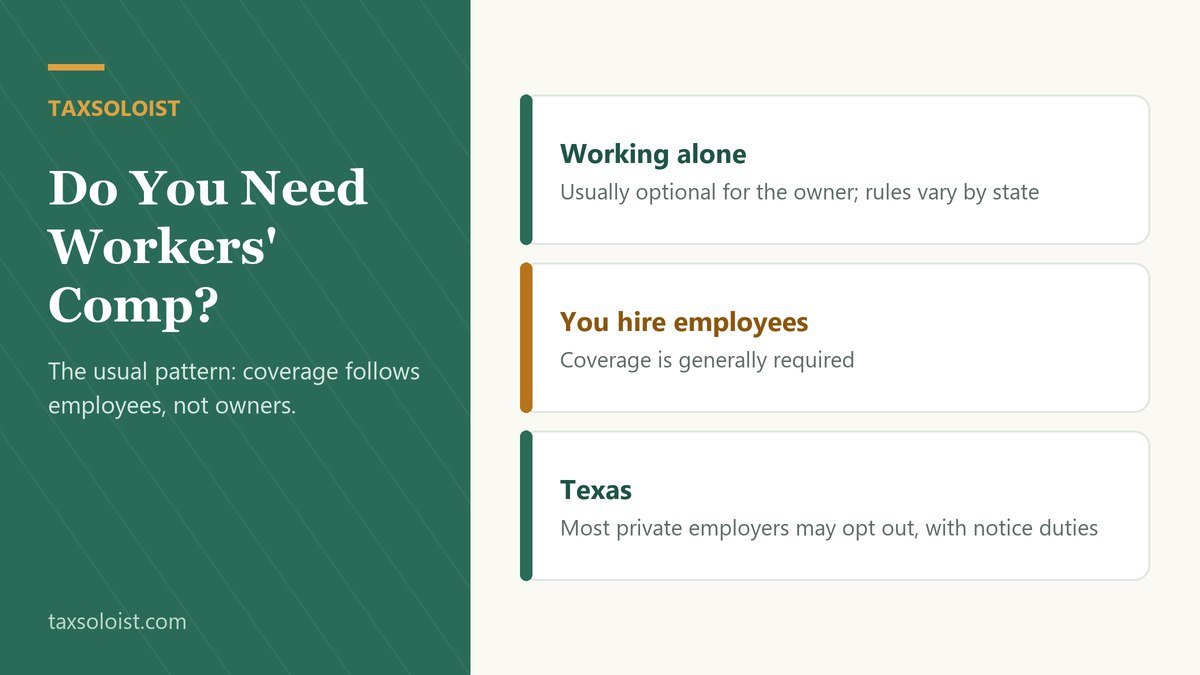
The general pattern: coverage follows employees, not owners
Workers’ compensation exists to cover employees who are hurt or made ill by their job. The owner of a sole proprietorship is not an employee of their own business in the legal sense, so owners working alone are typically left outside the mandate. Two official examples show the pattern clearly:
- New York: The Workers’ Compensation Board states that coverage is not required for a sole proprietor who does not have employees, and that a sole proprietor may voluntarily cover themselves under a workers’ compensation policy. It also states that coverage is required for sole proprietors with employees.
- Washington: The Department of Labor & Industries says owners of sole proprietorships are not required to carry workers’ comp coverage in the state, and that an owner who is exempt may choose elective coverage by applying to L&I.
Those two states are examples, not a rule for all fifty. Some states set thresholds, industry exceptions or special rules for owners, and those details change. If your state is not covered here, your state’s workers’ compensation agency website is the authoritative source, and most publish a plain-language “who must have coverage” page.
When you are working alone
If you are a one-person business, you are in the most common situation, and usually the one where coverage is optional. That said, “optional” still leaves a real question: what happens to you if you are hurt on a job? Workers’ compensation for employees pays medical costs and part of lost wages without anyone having to prove fault. When you are the owner and you are not covered, none of that exists for you. A back injury on a job site, a fall from a ladder or a repetitive-strain problem becomes a personal medical bill and a gap in income.
That is the decision at the heart of this topic. The law may not require you to buy the coverage, but you are deciding whether to self-insure the risk. Work that is physical, uses ladders, tools or vehicles, or happens on someone else’s property deserves more thought than work you do from a laptop at home.
When you hire employees
Hiring changes the picture. In the states discussed above, coverage is required once a sole proprietor has employees. Texas is the notable exception to the “employees means coverage” rule: the Texas Department of Insurance says private employers can choose whether to provide workers’ compensation coverage. Employers that decide not to are called non-subscribers, and they have to post notice of no coverage in the workplace, give new employees written notice, and file notices with the state’s Division of Workers’ Compensation, including an annual notice and a notice after hiring the first employee. Opting out is legal, but it is not free of consequences, so it is a decision to make with advice rather than by default.
Before your first hire, read our guide on the difference between a sole proprietorship and an independent contractor, because the rest of the hiring checklist (payroll, an employer identification number, state registration) is a separate set of obligations that sits alongside workers’ comp.
Workers who are really “contractors”: the misclassification trap
Many solo business owners avoid the question by paying helpers as independent contractors. Sometimes that is correct. Sometimes it is not. The U.S. Department of Labor explains that misclassification happens when an employer treats a worker who is legally an employee as an independent contractor, and that employers are responsible for determining a worker’s status. The Department’s guidance for the federal wage-and-hour law appears in 29 CFR Part 795, which a January 2024 final rule revised, and the details of how rules are applied can change, so check the current version.
The workers’ compensation angle matters because many states have their own tests, and those tests do not always match the IRS or the Department of Labor. If a helper you paid on a 1099 is later treated as an employee by your state, the question of workers’ comp coverage, and of back premiums, can come with it. If you are the person being paid as a contractor, our step-by-step guide to becoming an independent contractor explains what that status means for you.
California licensed contractors: the exemption certificate
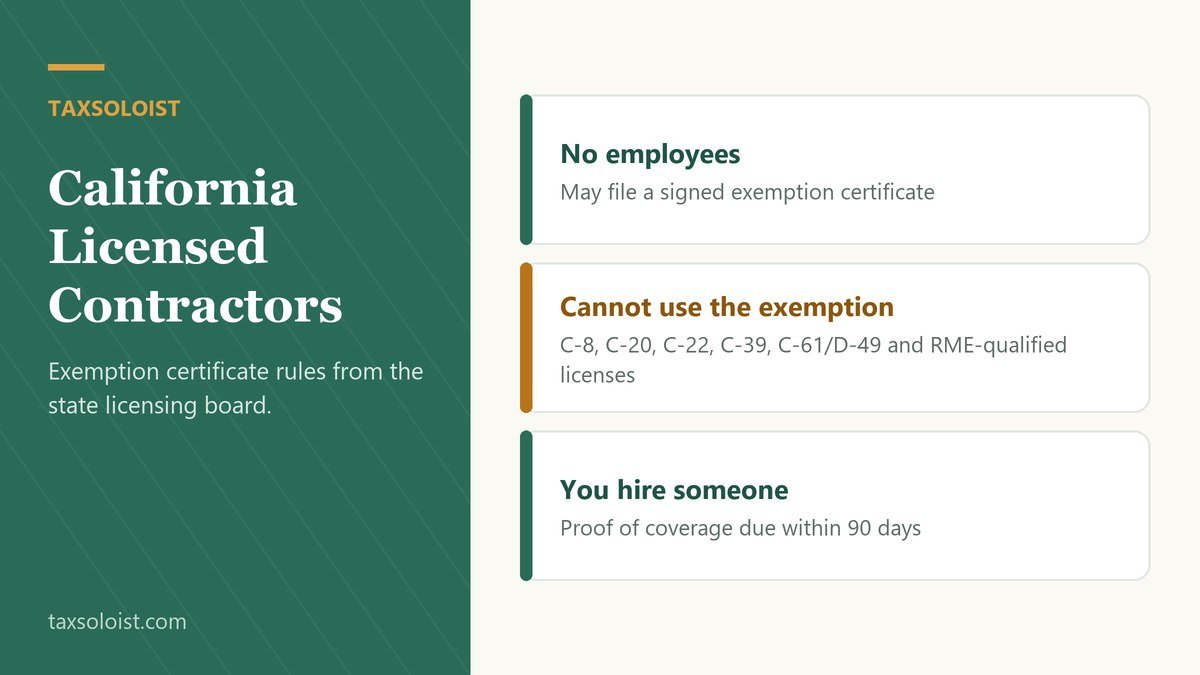
California is the clearest example of a place where “I work alone” is not the end of the story. The Contractors State License Board (CSLB) says employers, including construction employers, must carry workers’ compensation insurance. A licensee with no employees may instead file a signed exemption certifying that they have no employees at that time. There are firm limits:
- You cannot file the exemption if you employ anyone subject to California’s workers’ compensation laws.
- Licenses qualified by a Responsible Managing Employee (RME) are not eligible.
- Holders of the C-8, C-20, C-22, C-39 and C-61/D-49 classifications must carry coverage whether or not they have employees.
- If you hire employees after filing an exemption, proof of coverage must reach CSLB within 90 days of the hire.
- Failing to maintain coverage results in license suspension, and work done while suspended is treated as unlicensed.
CSLB has been working on changes to the exemption process, so the current CSLB workers’ compensation page, not a blog post, should be your final check if you hold a California contractor license.
When someone else makes you carry it
Even where the law says you do not need coverage, the person hiring you might. The New York Board’s own guidance points out that general contractors routinely require subcontractors to show proof of their own workers’ compensation coverage before they work on a project. The same pattern shows up with property managers, larger clients, and some insurance requirements in contracts. If a client’s contract says you must carry workers’ compensation, it is a contract term, and failing to meet it can cost you the job even if no law requires it.
If you often work as a subcontractor, ask for coverage requirements before you accept a project, not after. Related: the complete list of self-employed deductions is a useful companion, because several of the costs in this guide are deductible.
How workers’ comp premiums are typically set
Insurers generally price workers’ compensation based on the type of work being done (higher-risk trades pay more), the payroll being covered, and a business’s own claims history. The exact formulas and rate-setting rules are set state by state, and some states run their own insurance fund. Because the inputs differ so much from one business to another, any single cost number you read online is a rough guide at best. The reliable way to learn what coverage costs for your trade is to get quotes in your state, ideally from more than one source.
Occupational accident insurance: the common alternative
If workers’ comp is not available to you as an owner or independent contractor, or you simply want a different shape of protection, there is a separate product called occupational accident insurance. It is a private policy, not workers’ compensation, and it is built mainly for people who work as independent contractors. Policies typically offer benefits for work-related injuries, such as medical expenses, disability payments or accidental death benefits, but the coverage varies widely by insurer and the policy is not a state program, so the legal protections of the workers’ comp system do not automatically apply.
Read the exclusions carefully. Look at what counts as a covered accident, whether illness is covered, how long benefits last, and whether benefits pay you a fixed amount or reimburse actual costs. Compare it against your health insurance too: our guide to affordable health insurance options for the self-employed covers how those pieces fit together once it is live.
Is workers’ comp tax deductible?
For a business, yes, in the standard case. IRS Publication 334 (Tax Guide for Small Business, current edition for 2025 returns) lists workers’ compensation insurance required by state law among the deductible business insurance premiums, along with liability insurance, malpractice insurance covering your personal liability for professional negligence, and business vehicle insurance. The same section lists what is not deductible, including premiums for policies that pay your own lost earnings due to sickness or disability, with an exception for overhead insurance that covers business expenses during a long disability.
That second rule matters for occupational accident policies, because many of them pay a disability income benefit. Whether a particular premium is deductible depends on what the policy actually pays, so ask a tax professional before you assume. Use our Tax Deduction Calculator to see how a deduction changes your taxable income once you know the amount. Note that IRS Publication 535 is no longer published; its business-expense content now lives in Publication 334.
A practical decision checklist
- Do you have employees? If yes, assume coverage is required unless your state’s agency says otherwise (Texas lets most private employers choose, with notice duties).
- Do you hold a license? California contractors should check CSLB rules and classification before relying on an exemption.
- Do your clients require proof? Read contracts and bid requirements before you start.
- Is your work physically risky? If a serious injury would stop your income, price out elective coverage or occupational accident insurance.
- Do you pay helpers as contractors? Check whether your state would consider them employees.
- Do you have health and disability coverage? Decide what already covers an injury at work and what does not.
Common questions
Can an LLC owner skip workers’ comp? It depends on the state and on how the LLC is structured. Washington, for example, says LLC members are generally exempt but notes there are exceptions based on structure. Check your state’s rules for owners of LLCs and corporations rather than assuming the sole-proprietor rule carries over. Our guide on LLCs versus sole proprietorships for freelancers covers the other differences.
Does it matter if my family members help me? It can. Rules about family members who work in the business vary by state. Check the wording for your state before assuming helpers who are relatives are outside coverage.
What happens if I should have had coverage and did not? Penalties vary by state. In California’s contractor system, the CSLB says failing to maintain coverage results in license suspension. Other states have their own penalties, which can include stop-work orders and fines, so check yours before you hire.
Bottom line
If you work alone, workers’ compensation is usually optional by law, and the real decision is about risk, contracts and your license. If you hire anyone, expect to need it, and check your state’s rules and tests for who counts as an employee before you rely on a 1099 arrangement. Confirm the current rule with your state’s workers’ compensation agency, then decide whether elective coverage or an occupational accident policy fits your work.
Related guides
- Self-Employed Dental Insurance: Plans, Costs, and Tax Treatment
- Business Insurance for Independent Contractors: What You Need and What It Costs
- Mortgage Loans for Self-Employed: Requirements, Documents, and Bank Statement Options
- Current Mortgage Rates for the Self-Employed in Essex County
- MassHealth Guide: How to Provide Proof of Income as an Independent Contractor
Sources
- New York State Workers’ Compensation Board: Is Workers’ Compensation Coverage Required?
- Washington State Department of Labor & Industries: Common small business questions
- California Contractors State License Board: Workers’ Compensation Requirements
- Texas Department of Insurance: Non-subscriber information
- U.S. Department of Labor, Wage and Hour Division: Misclassification of employees as independent contractors
- IRS Publication 334: Tax Guide for Small Business