
✅ Current for tax year 2026
Quick answer: For federal income tax purposes, a single-member LLC and a sole proprietorship are taxed identically by default — both report business income on Schedule C. The real difference is legal liability protection and credibility, not a built-in tax break, and each comes with real tradeoffs the other doesn’t have.
What a sole proprietorship is
If you’re freelancing under your own name (or a DBA) with no formal entity filed anywhere, you’re already a sole proprietorship — it’s the default, not something you apply for. See Sole Proprietorship vs. Independent Contractor for how this default status works and why it’s separate from your worker classification.
What a sole proprietorship gives you
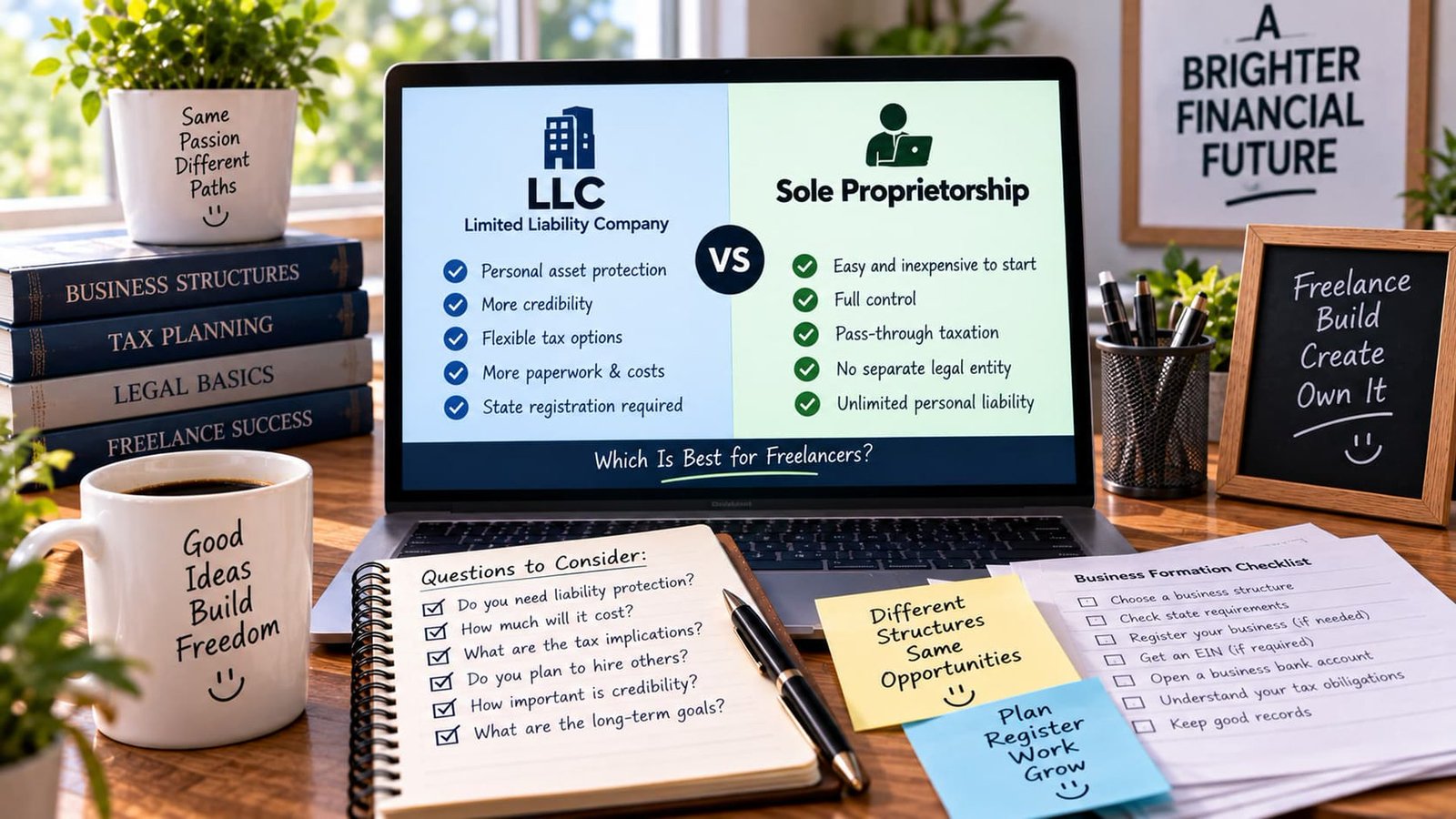
- Easy and inexpensive to start — no filing fee, no formation paperwork, no waiting period.
- Full control — no operating agreement, no separate governance requirements, no one to answer to but yourself.
- Pass-through taxation — business income and losses flow directly onto your personal return; no separate business tax return.
- No separate legal entity — which is convenient for simplicity, but is also exactly the source of its biggest downside.
- Unlimited personal liability — if the business is sued or can’t pay a debt, your personal assets (home, car, personal savings) are on the table, not just business assets.
What an LLC gives you
- Personal asset protection — this is the headline reason most freelancers eventually form one. An LLC creates legal separation between you and the business, generally shielding personal assets from business debts and lawsuits.
- More credibility — some clients, especially larger companies, simply feel more comfortable contracting with an “LLC” than an individual, even though the practical difference to them is often minimal.
- Flexible tax options — an LLC is taxed as a sole proprietorship by default, but can elect S-corporation taxation once profit justifies it, potentially reducing self-employment tax on part of the income.
- More paperwork and costs — state filing fees, potential annual report requirements, and in some states, franchise or annual LLC taxes regardless of profit.
- State registration required — unlike a sole proprietorship, you can’t just start; you have to file formation paperwork with your state before the protection exists.
| Sole Proprietorship | Single-Member LLC (default tax treatment) | |
|---|---|---|
| Liability protection | None — personal assets exposed | Generally shields personal assets |
| Default federal tax treatment | Schedule C | Schedule C (identical, unless you elect S-corp) |
| Setup cost/paperwork | None | State filing fee + ongoing compliance |
| Credibility with clients | Sometimes a minor factor | Often perceived as more established |
| QBI deduction eligible? | Yes | Yes |

The tax-only misconception
A common myth: “I need an LLC to get business deductions” or “to qualify for the QBI deduction.” Neither is true — a sole proprietorship gets identical deductions and identical QBI eligibility to a default-taxed LLC. See Can Gig Workers Claim the QBI Deduction Without an LLC? for the specifics. An LLC can later elect S-corporation taxation, which is a genuine self-employment tax strategy at higher income — but that election is a separate decision from simply forming the LLC itself, and it comes with payroll and compliance obligations of its own.
Questions worth asking yourself before deciding
- Do you actually need liability protection given the nature of your work?
- How much will formation and ongoing compliance cost in your specific state?
- What are the real tax implications for your income level right now?
- Do you plan to hire subcontractors or employees soon?
- How important is the perceived credibility to the clients you’re targeting?
- What are your long-term goals for the business — sale, growth, partners?
When an LLC actually makes sense
Consider one if your work carries real liability risk (client property, professional advice, physical services where something could go wrong), if you’re building a brand you might eventually bring partners into or sell, or if your income has grown enough that an S-corp election is worth exploring for self-employment tax savings. For a solo freelancer with low liability exposure and modest income, the added state filing fees and annual compliance often aren’t worth it yet — you can always form one later once the numbers justify it.
What forming an LLC actually involves
The process varies by state but generally includes filing formation paperwork (often called Articles of Organization) with your state’s business filing agency, paying a filing fee, and in some states, publishing a notice of formation or filing an annual report. Some states also charge an ongoing annual franchise tax or fee regardless of how much the LLC actually earns — a cost worth checking specifically for your state before assuming the LLC route is inexpensive everywhere.
A common misconception about liability protection
Forming an LLC doesn’t create absolute protection in every situation — if you personally guarantee a loan, commit fraud, or fail to keep your business and personal finances genuinely separate (a practice called “piercing the corporate veil” when courts disregard the LLC’s protection due to commingled finances), the liability shield can weaken or disappear entirely. An LLC is a real and valuable protection, but it depends on actually operating the business as a distinct entity — separate bank accounts, separate records, and not treating the LLC’s money as interchangeable with your personal funds.

Revisiting the decision as your business grows
The sole proprietorship vs. LLC decision isn’t permanent — many freelancers start as sole proprietorships and convert to an LLC once their income, client base, or liability exposure grows enough to justify it. There’s no penalty for waiting, and no requirement to decide this once and never revisit it. Reassess periodically, particularly any time your work changes in a way that increases risk (larger contracts, physical services, higher-profile clients) or your income grows enough that an S-corp election becomes worth exploring.
A middle-ground option worth knowing about: business insurance
For freelancers who want some liability protection without the paperwork and cost of forming an LLC immediately, professional liability insurance (sometimes called errors and omissions insurance) is worth considering as a partial alternative. It doesn’t provide the same personal-asset shield an LLC does, but it can cover claims related to mistakes or negligence in your specific line of work, often at a lower ongoing cost than LLC formation and compliance in certain states. Many freelancers use this as a stepping stone — insurance now, LLC formation once income and risk justify the additional structure.
State-by-state variation worth knowing about
LLC formation costs, ongoing fees, and specific requirements vary considerably by state — some states charge a modest one-time filing fee with minimal ongoing cost, while others impose a meaningful annual franchise tax regardless of the LLC’s actual profit. Before deciding, look up your specific state’s current LLC filing fee and any recurring annual cost, since this can meaningfully shift the cost-benefit calculation compared to simply staying a sole proprietorship, particularly in states with higher ongoing LLC maintenance costs.
Some freelancers who live in a state with high LLC costs but do most of their work with out-of-state or international clients occasionally explore forming an LLC in a different state — this is a more complex decision involving registered agent requirements and potential dual-state filing obligations, and it’s generally only worth exploring with professional guidance rather than as a simple cost-saving shortcut.
Bottom line
Don’t form an LLC expecting a tax break you don’t already have as a sole proprietorship — you don’t get one automatically. Form one when the liability protection, credibility, or a future S-corp election is worth the paperwork and cost. Either way, your day-to-day tax mechanics run through the same Schedule C.
Try it yourself: Wondering how much tax a sole proprietorship or LLC changes for your income? Estimate your self-employment tax with our Self-Employment Tax Calculator.
Related guides
- Can Sole Proprietors Have Employees? What You Need to Hire Legally
- How to Become an Independent Contractor: A Step-by-Step Guide
- How to Transition from Full-Time Employee to Successful Freelancer
- How to Register as Self-Employed Without the Stress
- Independent Contractor Lawyer: When You Need One and What It Costs
- Freelance Writer Tax Deductions: The Complete Write-Off List for 1099 Writers
- Freelance Graphic Designer Tax Deductions: Software, Hardware, and Home Studio Costs
- Freelance Web Developer and Web Designer Tax Deductions: Software, Hosting, Coworking, and Gear
- Do S Corp Owners Pay Self-Employment Tax? Reasonable Salary Rules and a Worked Example vs. LLC
- Gig Worker vs. Freelancer vs. Independent Contractor: What Each Label Means for Your Taxes
- How to File Taxes as an Independent Contractor: Forms, Deadlines, and What You'll Actually Owe
- After-Tax Cost of Debt: Formula, Example, and Business Interest Deductibility