
✅ Current for tax year 2026
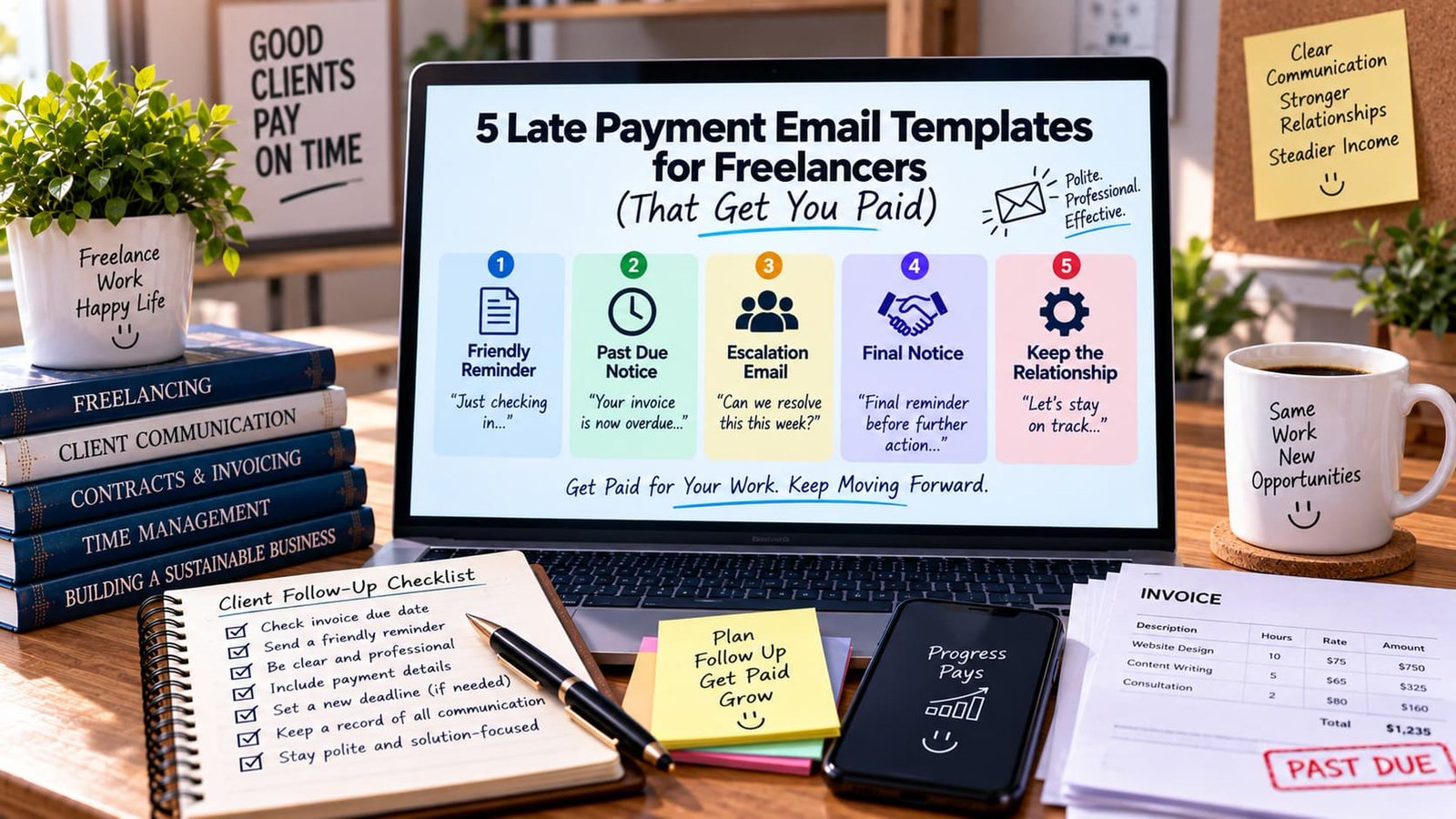
Quick answer: Escalate gradually and know when to stop escalating — a friendly reminder first, then a past due notice, then an escalation email, then a final notice, and finally, once payment lands, a note that keeps the relationship intact for future work. Five templates below, in the order you’d actually use them.
1. Friendly Reminder (a few days past due)
Hi [Client], hope things are well on your end. Just a quick note that Invoice #[number] for $[amount], due [date], hasn’t come through yet — wanted to flag it in case it slipped through. Let me know if you need anything from me to process it. Thanks!
Most late payments are administrative oversights, not disputes — this template resolves the majority of cases on its own, and it costs you nothing in tone or relationship goodwill.
2. Past Due Notice (1-2 weeks past due)
Hi [Client], following up on Invoice #[number] ($[amount]), which is now [X] days past its [date] due date. Could you confirm when payment will be processed? Happy to resend the invoice or answer any questions holding it up.
Note the shift in language here: explicitly stating the number of days overdue creates a paper trail and signals, without being aggressive, that you’re tracking this.
3. Escalation Email (2-4 weeks past due)
Hi [Client], Invoice #[number] ($[amount]) is now [X] days overdue with no response to my last two follow-ups. Per our agreement, late fees may apply after [X] days. I’d like to resolve this without needing to escalate further — please let me know a payment date by [specific date].
This is the point where referencing your contract terms (late fee clauses, if you have them) becomes appropriate — it shifts the tone from a courtesy nudge to a documented business matter.
4. Final Notice (before further action)
Hi [Client], this is a formal notice regarding Invoice #[number] ($[amount] plus any applicable late fees per our signed agreement dated [date]), now [X] days overdue. Please remit payment by [date] to avoid further action, which may include collections or small claims proceedings. I’m attaching the original signed agreement for reference.
Attaching the signed agreement here isn’t just for the client’s benefit — it’s you documenting your own paper trail in case this genuinely does need to escalate to collections or legal action later.
5. Keep the Relationship (once resolved)
Hi [Client], thanks for taking care of Invoice #[number] — appreciate it. Everything’s settled on my end. Looking forward to the next project whenever you’re ready.
This last template is the one freelancers most often skip, and it’s arguably the most valuable one for repeat business. A late payment that gets resolved and then never mentioned again tends to leave a slightly awkward residue in the relationship; a short, warm note that explicitly closes the loop signals that you’re not holding a grudge and are genuinely open to working together again.
Why the escalation order matters
Jumping straight to formal, legal-sounding language over an invoice that’s three days late damages client relationships you might otherwise keep for years. Save the firmer templates for when they’re actually earned by the situation — templates 1 and 2 resolve the large majority of late payments without ever needing template 3 or 4.
- Double-check the invoice was actually sent to the right contact and address
- Confirm your payment terms and any late fee clause from the original agreement
- Keep every email in one thread or folder — you may need the full record later
- Set a specific follow-up date after each template rather than sending them reactively
What to do when a client goes completely silent
Sometimes none of the five templates get a response at all. At that point, a phone call — not another email — is often the more effective next step; a written record is valuable, but a live conversation can surface whether there’s a genuine problem (a client’s own cash-flow issue, an internal approval delay) that email simply isn’t going to resolve. Follow up any phone conversation with a brief written summary email confirming what was agreed, so you still have documentation of the resolution.
Preventing the need for these templates in the first place
The best fix for late payment is upfront structure: clear payment terms in every contract, deposits or partial payment for larger projects, and automated payment reminders through your invoicing tool (see The Best Invoicing Tools for the Self-Employed) that go out before a client even has a chance to forget. Freelancers who build these habits in from the start tend to need the firmer templates far less often than those who only think about payment terms after a problem arises.

Knowing when to involve a collections service or small claims court
If a final notice goes unanswered and the amount is significant, a collections agency or small claims court (for amounts within your state’s small claims limit) becomes a reasonable next step — but this is genuinely a last resort, typically reserved for cases where the relationship is already effectively over and the primary goal has shifted from preserving the relationship to simply recovering what’s owed.
Adjusting the tone for long-term versus one-off clients
The templates above work as a general framework, but consider softening the language somewhat for a long-standing client with an otherwise excellent payment history who’s late for the first time — a brief, warm check-in may be more appropriate than even the first formal template. Conversely, for a one-off client with no track record and a large invoice outstanding, moving through the escalation sequence a bit faster than the suggested timelines may be reasonable, since there’s less established trust to lean on while waiting.
Documenting the pattern if late payment becomes chronic
If a particular client is consistently late across multiple projects, that’s data worth acting on directly — requiring upfront deposits, shortening payment terms, or declining future work with that client altogether are all reasonable responses to a demonstrated pattern, rather than repeating the same escalation sequence project after project with a client who has shown they’re unlikely to change.
Adapting these templates for different communication channels
While these templates are written as emails, the same escalating structure and tone work equally well adapted to a messaging platform (Slack, a project management tool’s comment thread) if that’s how you primarily communicate with a particular client. What matters more than the specific channel is maintaining a clear, dated record of each follow-up — screenshot or export message threads periodically if your primary client communication happens somewhere that doesn’t naturally preserve a searchable history the way email does.
Regardless of channel, resist the temptation to send a follow-up impulsively in the moment of frustration — drafting a message, setting it aside for even ten minutes, and reviewing it before sending tends to produce a more effective, appropriately calibrated message than one sent immediately after noticing a payment is late.
Bottom line
Having these ready before you need them means you send the right tone immediately instead of drafting from scratch while frustrated. Pair a clear invoicing process — see The Best Invoicing Tools for the Self-Employed — with these templates so late payments become the rare exception, not the norm, and so the relationship survives even the ones that do happen.
Related guides
- Independent Contractor Invoice Template (Free Word, Google Docs, PDF)
- Best Accounting Software for Self-Employed Professionals (Ranked)
- Independent Contractor Payroll Software: How to Pay, Manage, and Report 1099 Workers
- Freelance Hourly Rate Calculator: How to Price Your Services
- 15 Time Management Tools Every Freelancer Needs
- Freelance Graphic Designer Tax Deductions: Software, Hardware, and Home Studio Costs
- Freelance Photographer Tax Write-Offs: Gear, Depreciation, Travel, and Studio Costs
- How Interest Is Calculated: Loans, CDs, and Money Market Accounts (With Excel Formulas)
- How to Set Firm Boundaries with Freelance Clients (Without Losing Them)