
✅ Current for tax year 2026
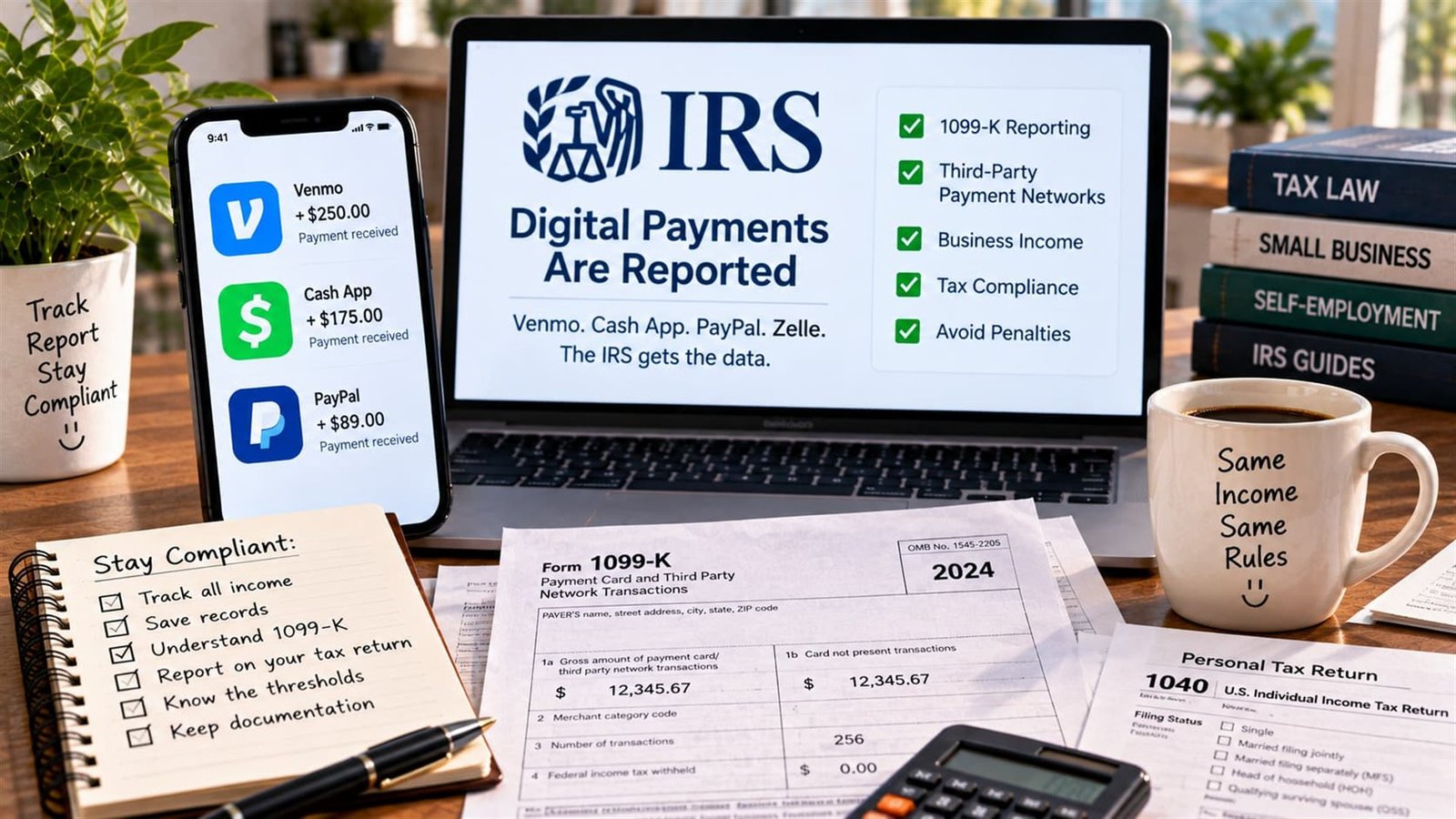
Quick answer: Yes — if you’re receiving business payments through Venmo, Cash App, PayPal, or Zelle, the IRS can see it, either through a 1099-K these platforms issue once you cross the reporting threshold, or through their own records even below that threshold.
The 1099-K threshold, and why it’s not the whole story
For 2026, payment platforms issue a 1099-K once you receive $20,000 and 200 transactions in a calendar year for goods and services — a threshold that’s bounced around for years before Congress restored this original figure. But the reporting threshold is a paperwork trigger, not a tax-liability line. You owe tax on all your self-employment income, whether a 1099-K arrives or not.

“Friends and family” payments are different
Venmo and similar apps let you mark a payment as personal (splitting dinner, paying back a friend) versus for goods and services. Personal payments between friends aren’t taxable income and don’t generate a 1099-K, regardless of amount. The rules only apply to payments received for work, goods, or services — mislabeling business income as “personal” to dodge a form doesn’t change what you actually owe, and payment platforms have gotten more aggressive about flagging accounts that look like they’re doing this.
What “the IRS can see it” actually means
It doesn’t mean an agent is watching your account in real time. It means that if a platform issues a 1099-K in your name, the IRS’s systems have that figure on file — and if the income you report on your return doesn’t roughly match it, an automated matching program can flag the mismatch and generate a notice.
The safest approach
Report your actual self-employment income regardless of what forms do or don’t arrive, keep your own records of what you earned and from whom, and use those numbers — not just whatever a 1099-K says — as your source of truth. If you take payment through several apps and platforms, add them all up; that combined total is what belongs on your return.
See where that leaves your tax bill
Once you know your real total, the 1099 & quarterly tax calculator turns it into a self-employment tax and income tax estimate.
Venmo, PayPal, Zelle — they’re not all the same
Venmo, PayPal, and Cash App are payment processors that can issue a 1099-K because money sits in an account they control before you transfer it out. Zelle works differently — it’s a direct bank-to-bank transfer network, so no Zelle-branded 1099-K exists, regardless of how much you receive through it. That doesn’t mean Zelle income is invisible or untaxed; it just means the reporting mechanism is different, and your bank’s own records — not a platform-issued form — are what would surface it if ever reviewed. Business owners sometimes assume Zelle is a loophole for this reason. It isn’t one: the obligation to report the income is identical no matter which app moved the money, only the paper trail differs. Even below the 1099-K threshold, most payment apps retain years of transaction history that can be requested in an audit — the absence of an automatically issued form doesn’t mean the records don’t exist somewhere.
What about crypto payments?
Increasingly, some freelancers and small sellers accept payment in cryptocurrency instead of, or alongside, apps like Venmo and Cash App. The reporting mechanics differ — there’s no 1099-K equivalent triggered by a crypto wallet the way there is for payment apps — but the underlying tax obligation is identical: payment received for goods or services is taxable income at its fair market value in dollars on the date received, regardless of the form it arrives in. Crypto adds a second layer on top of that: converting or selling it later can trigger a separate capital gains calculation based on how its value changed since you received it. That second layer is outside what a 1099-K-style form would ever capture, making your own records even more essential than with dollar-based payment apps.
Related guides
- OnlyFans Taxes: What You Actually Owe After the 20% Platform Fee
- What Really Happens If You Forget to Report a 1099
- eBay Seller 1099s: What Changed and What You Actually Owe
- No Tax on Tips: What It Means for Gig Workers 2025-2028
- DoorDash, UberEats, and Instacart: How Much Can You Make as an Independent Contractor?
- No Tax on Tips: IRS’s February 2026 Instruction Change for Gig Workers
- StubHub, Sneakers, and Marketplace Flips: When Reselling Becomes Taxable Income
Sources
1099-K threshold figures reflect the 2025 One Big Beautiful Bill Act’s restoration of the $20,000/200-transaction threshold — see the IRS’s official Form 1099-K page. This is general information, not tax advice.