

✅ Current for tax year 2026
Quick answer: Most independent contractors should start with two things: general liability insurance (covers injury and property-damage claims from your work) and professional liability, also called errors and omissions insurance (covers claims that your advice or work was wrong or negligent). Depending on your trade, you may also need commercial auto, equipment coverage, or a home-business policy, and your clients may require proof of coverage in the contract. What it costs depends on your trade, location, claims history and limits, so the only dependable figure is a quote from a licensed agent in your state.
Why independent contractors need their own coverage
When you work as an employee, the employer’s insurance sits behind you. Make a mistake on the job, and the company’s policies deal with it. As an independent contractor, you are the business. If a client says your work caused a loss, or someone is injured at a job site, the claim comes to you personally unless you have a policy in place or have set up a business entity that limits your exposure. (An entity does not replace insurance; see our comparison of an LLC and a sole proprietorship for freelancers.)
The Small Business Administration puts the guiding principle simply: insure against the risks you could not cover yourself. Start from the risks of your own work: what could go wrong, what it would cost, and whether you could pay for it out of savings.
The core policies, in plain language
General liability insurance
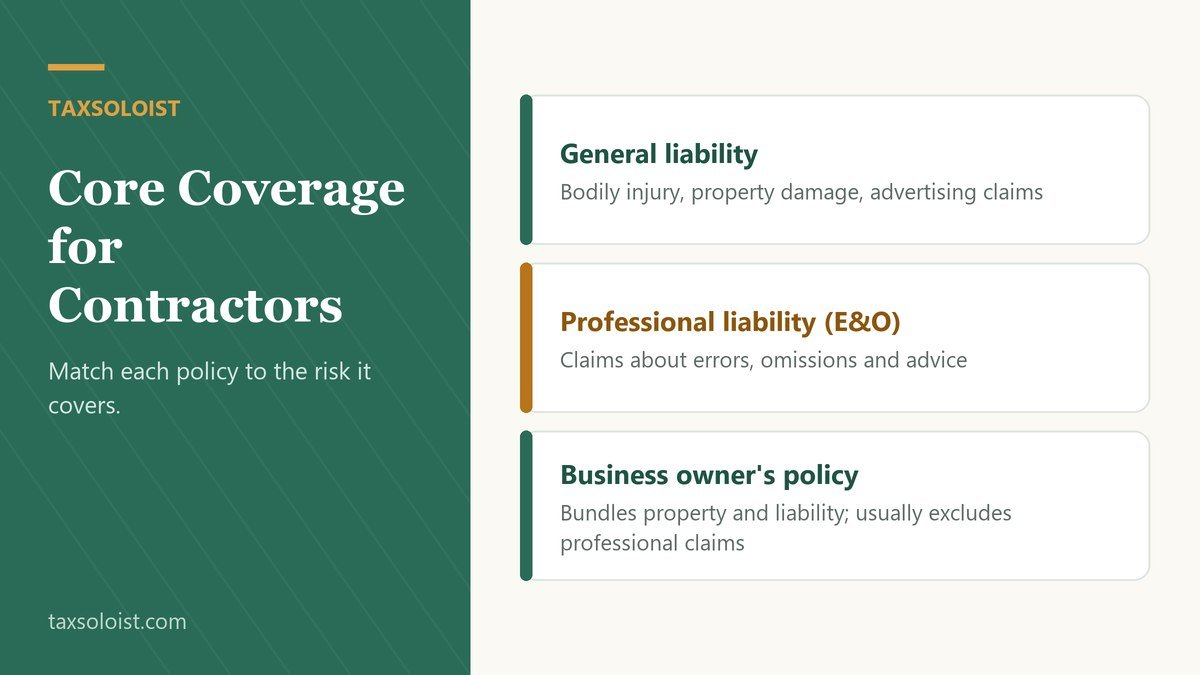
The National Association of Insurance Commissioners (NAIC) describes commercial general liability (CGL) as coverage for bodily injury, damage to other people’s property, personal injury such as slander and libel, and false or misleading advertising. It can pay an injured person’s medical bills and the legal costs of defending a lawsuit. The SBA lists it as insurance any business can use.
For a contractor, the picture is usually practical: a client’s visitor trips over your equipment, you damage a floor while setting up, or a tool you leave out causes an injury. General liability is built for that kind of claim.
Professional liability (errors and omissions)
Professional liability insurance covers claims arising from wrongful professional practices, such as an error, an omission or negligent advice. NAIC says a standard general liability policy excludes this risk, with professional errors such as failure to provide appropriate advice not covered. That is the gap that catches many consultants, designers, writers, bookkeepers, technology contractors and other service providers, because they assume “business insurance” means one policy that covers everything. It does not.
If your deliverable is advice, a design, code, a report or a plan, and a client could claim they lost money because of it, ask about professional liability in addition to general liability.
The business owner’s policy (BOP)
A BOP is a package. NAIC describes it as typically including property, business-interruption and liability coverage, and says it can cost less than buying the pieces separately. SBA likewise describes it as bundling the typical options into one package and notes that it suits most small owners, especially home-based ones. The important detail is what a BOP typically leaves out: NAIC says it excludes commercial auto, workers’ compensation, health or disability insurance, and professional liability claims. You may need to add or buy those separately.
Coverage that depends on how you work
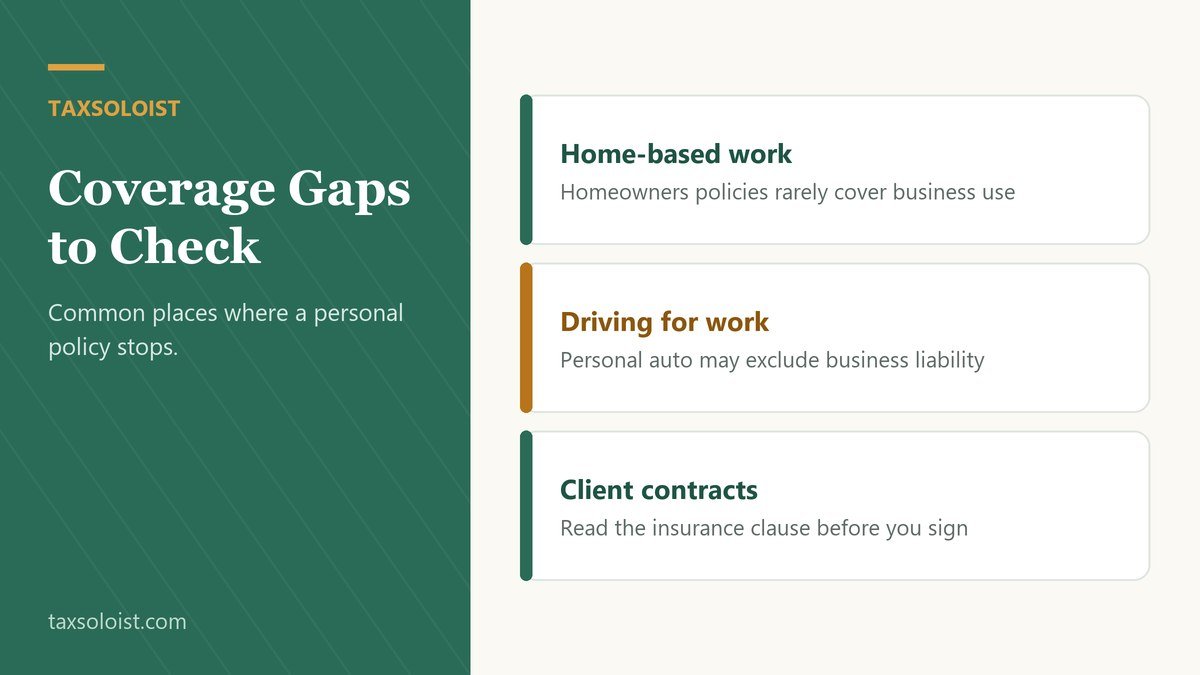
- Home-based work: NAIC warns that homeowners’ or renters’ policies are rarely adequate for a home-based business. Standard policies limit coverage for business property to a small amount, tend to exclude business-related liability claims, and provide no income protection if a loss shuts you down. A business endorsement or a home-business policy is the usual fix.
- Driving for work: If you use a vehicle for business, a personal auto policy may exclude business-related liability. NAIC says commercial auto policies typically carry higher liability limits and can extend to rented and non-owned vehicles. Ask your insurer how it treats your specific use, such as hauling tools, deliveries or driving between client sites.
- Tools and equipment: If a laptop, camera, tools or other gear is how you earn money, check whether your current policies cover business property, and at what limit, before a loss happens.
- Data and online work: NAIC notes that cyber liability coverage exists for web-based businesses facing damages from hackers and viruses. If you store client data, it is worth asking about.
- Injury to yourself: None of the policies above pay for your own on-the-job injuries. Read our guide on workers’ comp for the self-employed for how that gap is handled.
What your clients may require
Insurance is often a contract term before it is a legal one. Larger clients, property managers and general contractors commonly require independent contractors to show proof of coverage before starting work. Typical requests include:
- A certificate of insurance (COI) from your insurer or agent showing the policies and limits you carry.
- Minimum coverage limits written into the contract.
- Naming the client as an additional insured on your policy, which gives them certain rights under it.
- Proof that you also carry workers’ compensation, or documentation of why you are exempt.
The key habit is to read the insurance clause before you sign, and to ask your agent whether the policy you are buying actually meets it. A contract can require a certain limit or an endorsement that a basic policy does not include, so finding that out after you win the job costs you time and sometimes the job itself.
Licenses and bonds: related but different
Some trades also need a state or local license, and licensing rules may include their own insurance or bond requirements. Those rules differ by state and profession. A bond, for example, is a separate financial guarantee, not the same thing as liability insurance. Check your state licensing board for your trade, and do not assume a requirement in one state applies in another.
What it costs, and what moves the price
Because the question in the search box is almost always “how much,” here is the honest answer: no single number applies to independent contractors as a group. Premiums depend on several things, which is why quotes for two people with the same job title can look very different:
- Your trade and risk level: Physical, on-site work generally costs more to insure than desk-based advisory work.
- Coverage limits and deductibles: Higher limits and lower deductibles typically raise the premium.
- Revenue and payroll: Insurers often rate on how much business you do.
- Claims history: Prior claims can raise a quote.
- Location: State rules and local claim patterns affect pricing.
- Policy structure: A BOP can cost less than buying each coverage separately, according to NAIC.
SBA’s advice on shopping is to assess your risks, find a licensed agent who focuses on your needs, and compare rates and terms from several agents. NAIC adds that you should choose an agent who knows your business and review your policies at least once a year, especially after changes. If a number you see online has no stated trade, state and coverage limit behind it, treat it as a marketing figure.
Is business insurance tax deductible?
Generally, yes. IRS Publication 334 (Tax Guide for Small Business, current edition for 2025 returns) lists these among deductible insurance premiums: liability insurance, malpractice insurance covering your personal liability for professional negligence, fire, theft and flood insurance, workers’ compensation required by state law, and car or other vehicle insurance for business use (though if you use the standard mileage rate, you cannot deduct car insurance premiums separately). It also lists overhead insurance that pays business expenses during a long disability caused by your injury or sickness.
The same publication says premiums for policies that pay your own lost earnings due to sickness or disability are not deductible, and that you cannot deduct amounts credited to a reserve you set up for self-insurance. If you pay for a policy that covers both your business and personal risks, ask a tax professional how to treat it. To see the effect of an insurance deduction on your taxable income, try the Tax Deduction Calculator, and see where insurance fits among your other write-offs in the complete list of self-employed deductions.
Build the cost into your prices
Insurance premiums are a real cost of doing business, and they belong in your rates from the start. If you price your work without them, your actual income is lower than you think. Our freelance hourly rate guide shows how to include overhead like this when you set what you charge.
How to buy: a step-by-step approach
- List your risks. Write down what could go wrong in your work: injury, property damage, a client claiming your advice cost them money, theft of equipment, a data problem.
- Read your contracts. Note every insurance requirement: limits, additional-insured language, proof of coverage.
- Check what you already have. Review your homeowners or renters policy and your auto policy for business exclusions.
- Talk to a licensed agent who understands your trade. Ask what a BOP includes and excludes, and whether professional liability is available as a rider or a standalone policy.
- Get more than one quote. Compare limits, deductibles, exclusions and total cost, not only the monthly price.
- Keep your certificate of insurance ready. Clients tend to ask for it at the start of a job.
- Review every year. Update coverage when your work, equipment or income changes.
Common questions
Does an LLC replace insurance? No. An LLC can limit certain personal liability for business debts, but it does not pay for a claim, cover your own mistakes the way professional liability does, or satisfy a client’s insurance clause. Read more in our guide to the difference between a sole proprietorship and an independent contractor.
I just started. Do I need everything at once? Not necessarily. Many new contractors begin with general liability, professional liability if their work is advice-based, and any coverage a client requires, and then add more as their work grows. The step-by-step guide to becoming an independent contractor covers the other early decisions.
Does my health insurance cover my business risks? No. Health insurance, disability insurance and business liability insurance are separate products. NAIC says a BOP typically excludes health or disability insurance for that reason.
Bottom line
Start with the risks your work actually creates, match them to general liability, professional liability and any trade-specific coverage, and compare quotes from licensed agents. Check every client contract for insurance requirements before you sign. Because premiums depend on your trade, state and limits, treat any cost figure that is not tied to a quote for your situation with caution, and recheck your coverage whenever your work changes.
Related guides
- Affordable Health Insurance Options for the Self-Employed
- Self-Employed Dental Insurance: Plans, Costs, and Tax Treatment
- How to Avoid Self-Employment Tax Legally: 9 Strategies That Work
- Can Gig Workers Claim the QBI Deduction Without an LLC or Sole Proprietorship?
- Schedule C, Line by Line: The Freelancer’s Walkthrough
- Can You Deduct Moving Expenses for Your Business?