
✅ Current for tax year 2026
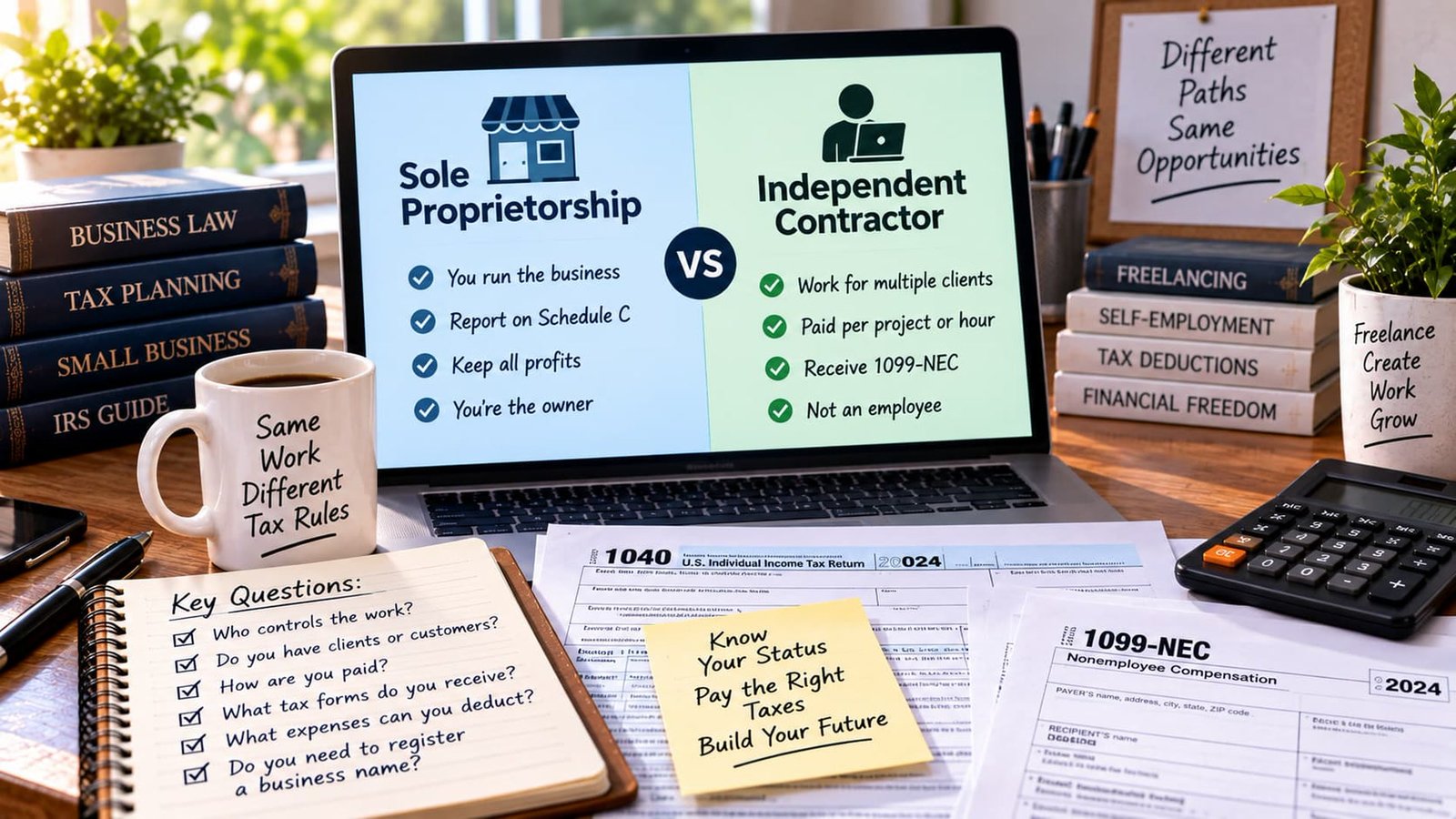
Quick answer: These two terms answer two different questions — “independent contractor” describes your worker classification, while “sole proprietorship” describes your business structure. Most gig workers are both at once, without ever having chosen either label on purpose.
Independent contractor is a worker classification
“Independent contractor” is the answer to one specific question: are you an employee of the company you’re doing work for, or not? The IRS and Department of Labor use various tests — control over how the work gets done, who provides the tools, whether the relationship is ongoing — to draw that line. The practical result shows up on your tax documents: an employee gets a W-2 with taxes already withheld; an independent contractor gets a 1099 with nothing withheld.
Sole proprietorship is a business structure
“Sole proprietorship” answers a completely different question: what legal form does your business take? It’s the default structure for any one-owner business that hasn’t filed paperwork to become an LLC, corporation, or partnership. If you’re an independent contractor and you haven’t registered a separate business entity, you are, automatically, a sole proprietorship — there’s no separate application or approval step.
| Independent Contractor | Sole Proprietorship | |
|---|---|---|
| Question it answers | Are you an employee? | What’s your business’s legal structure? |
| Determined by | The company/platform you work for, per IRS/DOL rules | You, by default, unless you register another entity |
| Shows up as | 1099 instead of W-2 | Schedule C on your Form 1040 |
Why the distinction matters at tax time
Regardless of how many platforms or clients classified you as a contractor, all of that income and all of your business expenses land on one Schedule C, because you’re operating as one sole proprietorship — not one Schedule C per client. See the line-by-line Schedule C walkthrough for how that consolidation actually works on the form.
A few concrete scenarios
- A rideshare driver working for one platform is an independent contractor (worker classification) and a sole proprietorship (business structure), by default, with no extra steps taken.
- A freelance designer with three regular clients is still one sole proprietorship overall, even though each client relationship independently makes them a contractor rather than an employee of that specific client.
- A contractor who forms an LLC changes their business structure but not their worker classification — they’re still an independent contractor to their clients, just operating through an LLC instead of as a sole proprietorship. See LLC vs. Sole Proprietorship for that decision.
- A worker misclassified as a contractor when the actual working relationship looks like employment is a worker-classification problem, not a business-structure one — this is a separate, more serious issue involving the company’s own compliance, not something the worker’s own filing choices affect.

When people confuse the two
The most common mix-up: assuming you need to “become a business” — form an LLC, register with the state — before you can claim business deductions or the QBI deduction. You don’t. See Can Gig Workers Claim the QBI Deduction Without an LLC? for why sole proprietorship status alone is enough.
When to consider moving beyond sole proprietorship
None of this means a sole proprietorship is always the right long-term structure. As net profit grows, some self-employed filers look at an LLC for liability protection, or an S-corp election specifically to reduce the self-employment tax on part of their income. That’s a bigger decision with real tradeoffs — worth a conversation with a tax professional once your numbers justify it, rather than something to default into early. See How to Become an Independent Contractor for the fuller sequence of decisions this fits into.
What happens if a company misclassifies you
Worker misclassification — when a company treats someone as an independent contractor despite the working relationship actually resembling employment — is a genuine legal issue, but it’s one the hiring company bears most of the compliance risk for, not you as the worker. If you suspect misclassification (consistent set hours, required use of company equipment, no ability to work for other clients, ongoing indefinite work), it’s worth understanding your position, since a genuine misclassification can affect your eligibility for benefits, overtime protections, and how your taxes should have been handled. This is a separate issue from your own sole proprietorship status, which remains your default business structure regardless of how any individual client classifies the relationship.
How this plays out with multiple simultaneous clients
A common scenario: someone works as an independent contractor for three different companies at once, none of which employ them directly. Each individual relationship is evaluated separately for worker classification purposes, but all three income streams land on the same person’s same Schedule C, under the same sole proprietorship, at tax time. This is exactly why understanding the distinction matters practically — you don’t file three separate “businesses,” even though you have three separate contractor relationships.

Where an EIN fits into this picture
Some sole proprietors apply for an Employer Identification Number specifically to avoid sharing their Social Security number with every client on a W-9 form — this doesn’t change your business structure or worker classification at all, it’s purely a taxpayer-identification convenience. See How to Register as Self-Employed Without the Stress for more on when and why to get one.
How this distinction plays out for platform-based gig workers specifically
Rideshare and delivery platforms have faced significant legal and regulatory scrutiny over worker classification in various jurisdictions, with ongoing debate about whether platform workers should be classified as independent contractors or employees under certain state laws. Regardless of how this evolves in any specific state or platform, the underlying concept discussed in this article stays true: worker classification (contractor vs. employee) and business structure (sole proprietorship vs. LLC vs. something else) remain two separate questions, even as the rules governing the first one continue to be actively debated and occasionally change.
A final practical takeaway
If you take nothing else from this distinction, take this: don’t let uncertainty about your “business” status stop you from claiming legitimate deductions, contributing to a retirement account, or otherwise operating like the sole proprietorship you already are. The paperwork and labels can feel intimidating, but for the vast majority of gig and freelance workers, the actual structure is already in place the moment they start earning 1099 income — no additional action required to unlock the tax treatment that comes with it.
How tax software handles this distinction automatically
In practice, most tax software never asks you to explicitly declare whether you’re a “sole proprietorship” — it simply asks about your 1099 or self-employment income and walks you through Schedule C based on your answers, applying the sole proprietorship treatment automatically behind the scenes. This is part of why the distinction can feel abstract or confusing: the software handles the business-structure classification silently, while the worker-classification question (contractor vs. employee) was already settled earlier, at the point the company that paid you decided to issue a 1099 rather than a W-2.
Understanding the underlying concepts covered in this article still matters, even though software handles the mechanics — it’s what lets you catch a genuine misclassification issue, correctly answer questions about business structure on a loan or benefits application, and make an informed decision about whether to eventually move beyond a sole proprietorship as your situation changes.
Bottom line
“Independent contractor” and “sole proprietorship” aren’t competing labels — most gig and freelance workers are both simultaneously, and understanding which question each term answers clears up a lot of confusion about what paperwork you actually need, and what you don’t.
Try it yourself: See what self-employment tax you would owe as a sole proprietor or independent contractor with our Self-Employment Tax Calculator.
Related guides
- Can Sole Proprietors Have Employees? What You Need to Hire Legally
- How to Transition from Full-Time Employee to Successful Freelancer
- Independent Contractor Lawyer: When You Need One and What It Costs
- How to File Taxes as an Independent Contractor: Forms, Deadlines, and What You'll Actually Owe
- Gig Worker vs. Freelancer vs. Independent Contractor: What Each Label Means for Your Taxes