
✅ Current for tax year 2026
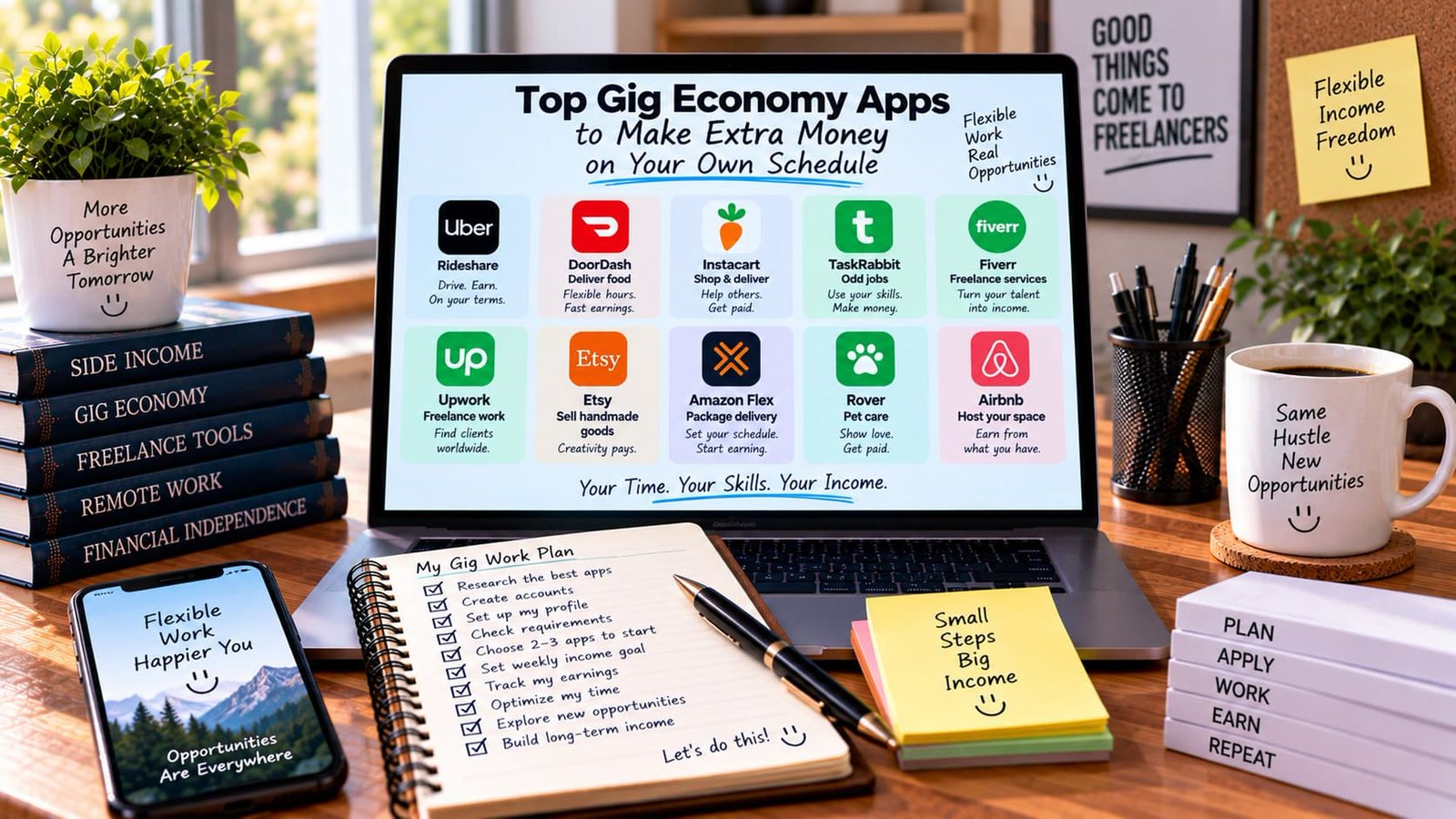
Quick answer: Ten platforms consistently top the list for flexible, self-directed gig work — Uber, DoorDash, Instacart, TaskRabbit, and Fiverr on one side, and Upwork, Etsy, Amazon Flex, Rover, and Airbnb on the other. Regardless of which you pick, the underlying tax rules are identical.
Uber — rideshare, drive on your terms
The original flexible-schedule gig app, and still one of the most accessible entry points if you have a qualifying vehicle. Set your own hours, log on and off whenever suits you.
DoorDash — deliver food, flexible hours, fast earnings
See DoorDash, UberEats, and Instacart: How Much Can You Make? for a realistic look at gross vs. net earnings, and the full DoorDash deduction list for what actually comes off your taxable income.
Instacart — shop & deliver, help others get paid
A grocery-focused variant of the delivery model, often run alongside DoorDash or UberEats by drivers who “multi-app” across platforms during peak hours.
TaskRabbit — odd jobs, use your skills
For handyman work, moving help, furniture assembly, and similar one-off tasks — TaskRabbit lets you set your own rates per job rather than accepting a fixed algorithmic offer, which suits people with specific physical or trade skills.

Fiverr — freelance services, turn your talent into income
A packaged-service marketplace where you list specific deliverables at set prices, rather than bidding hourly — well suited to creative and digital services (design, writing, voiceover, video editing — see 10 High-Paying Freelance Skills for categories that do especially well here).
Upwork — freelance work, find clients worldwide
The largest general freelance marketplace, built around proposals and hourly or fixed-price contracts rather than fixed service listings — a strong complement to Fiverr for freelancers who want to pitch directly on larger or longer-term projects.
Etsy — sell handmade goods, creativity pays
Its own category of gig income entirely — selling physical or digital creative goods rather than performing a service. It comes with its own reporting quirks around 1099-Ks; see eBay Seller 1099s: What Changed and What You Actually Owe for how marketplace-seller reporting generally works, since the underlying rules are similar across resale and handmade-goods platforms.
Amazon Flex — package delivery, set your own schedule
A block-based delivery model — you reserve delivery windows in advance rather than accepting orders in real time the way DoorDash or UberEats work, which suits people who prefer scheduling certainty over pure flexibility.
Rover — pet care, show love, get paid
Pet sitting, dog walking, and boarding, priced and scheduled by you directly with pet owners — a genuinely different skill and time commitment than delivery or rideshare work, often appealing to people who want gig income without being tied to a vehicle.

Airbnb — host your space, earn from what you have
Renting out a spare room or property is its own category of self-employment income, with somewhat different recordkeeping (occupancy-based expense allocation, for instance) than service-based gig work — worth researching its specific Schedule C or Schedule E treatment separately if this is a path you’re considering.
- Research which apps fit your schedule, skills, and local market
- Create accounts and set up your profile on 2-3 to start
- Check each platform’s specific requirements (vehicle, background check, etc.)
- Set a weekly income goal
- Track your earnings and expenses from day one
- Optimize your time across platforms once you know what works
- Explore new opportunities as you get comfortable
- Build toward long-term, sustainable income rather than just quick cash
Choosing where to spend your extra hours
The “best” app is the one that fits your schedule, skills, and local market — not a universal winner. Delivery and rideshare apps favor flexible availability during peak hours; task and pet-care apps favor specific skills or reliability; marketplace and freelance platforms favor people willing to build a portfolio or inventory over time. Run your projected earnings from any of them through the Self-Employment Tax Calculator before committing significant hours, so you know what you’re actually keeping after taxes.
How background checks and onboarding differ across these apps
Delivery and rideshare apps (Uber, DoorDash, Instacart, Amazon Flex) typically require a background check and, for driving-based work, a vehicle inspection or minimum vehicle age requirement, with onboarding often taking anywhere from a few days to a couple of weeks. Marketplace and freelance platforms (Upwork, Fiverr, Etsy) generally have lighter onboarding but require building a profile or storefront that attracts clients — a slower ramp-up but with more long-term earning ceiling for those who invest in it. Understanding this tradeoff up front helps set realistic expectations for how quickly you can actually start earning on each.
What “your own schedule” actually means in practice
Flexibility varies more than the marketing suggests. Rideshare and delivery apps genuinely let you log on and off whenever you want, but earnings are meaningfully better during predictable peak windows — true flexibility with a real cost in lower earnings during off-peak hours. Task-based and marketplace platforms offer a different kind of flexibility: you set your own hours entirely, but income depends on winning individual jobs or contracts rather than simply being available, which suits a different kind of schedule and risk tolerance.

Diversifying across platforms as a risk management strategy
Relying on a single gig platform carries real risk — a change in the platform’s pay structure, an account suspension, or reduced demand in your area can eliminate income with little warning. Many experienced gig workers deliberately maintain activity across two or three platforms from different categories (say, one delivery app and one freelance marketplace) specifically so no single platform’s policy change or demand shift can eliminate their entire income at once.
How to evaluate a new or lesser-known gig app before committing time
Beyond the ten platforms listed above, new gig apps launch regularly, often with aggressive early sign-up bonuses to build their initial workforce. Before investing significant time in an unfamiliar platform, check independent reviews from other workers (not just the platform’s own marketing), verify how and when payouts actually happen, and start with a small time commitment until you’ve confirmed the platform delivers on its stated pay structure reliably.
What changes once gig income becomes a primary source rather than a side activity
Everything about quarterly taxes, recordkeeping, and deduction tracking becomes considerably more important once gig income shifts from occasional extra money to your primary income source. At that point, it’s worth treating the work with the same seriousness as any other self-employed business — proper bookkeeping, a genuine quarterly tax habit, and a realistic look at whether retirement savings and health insurance planning (see the relevant guides linked throughout this article) need more deliberate attention than they did when this was just supplemental income.
A final word on treating gig work as a genuine business
Regardless of which of these ten platforms you choose, or how many hours you dedicate to them, treating gig income with the same seriousness as any other self-employment income — accurate records, quarterly tax planning, and deliberate tracking of what’s actually profitable — is what separates gig workers who build a sustainable income from those who feel like they’re working hard without much to show for it once taxes and expenses are accounted for.
Bottom line
Multi-apping across several of these categories is common and completely fine tax-wise — just keep one running record of all of it, since every dollar lands on the same return either way.
Related guides
- No Tax on Tips: IRS’s February 2026 Instruction Change for Gig Workers
- Stripe Express Guide: What Should Be the Statement Descriptor for Contractors?
- No Tax on Tips: What It Means for Gig Workers 2025-2028
- 1099 vs. W-2 Calculator: What the Same Salary Actually Costs You in Taxes
- What Really Happens If You Forget to Report a 1099
- Mileage Deduction Calculator
- Gig Worker vs. Freelancer vs. Independent Contractor: What Each Label Means for Your Taxes
- Can Gig Workers and 1099 Contractors Collect Unemployment? State Rules and Exceptions