
✅ Current for tax year 2026
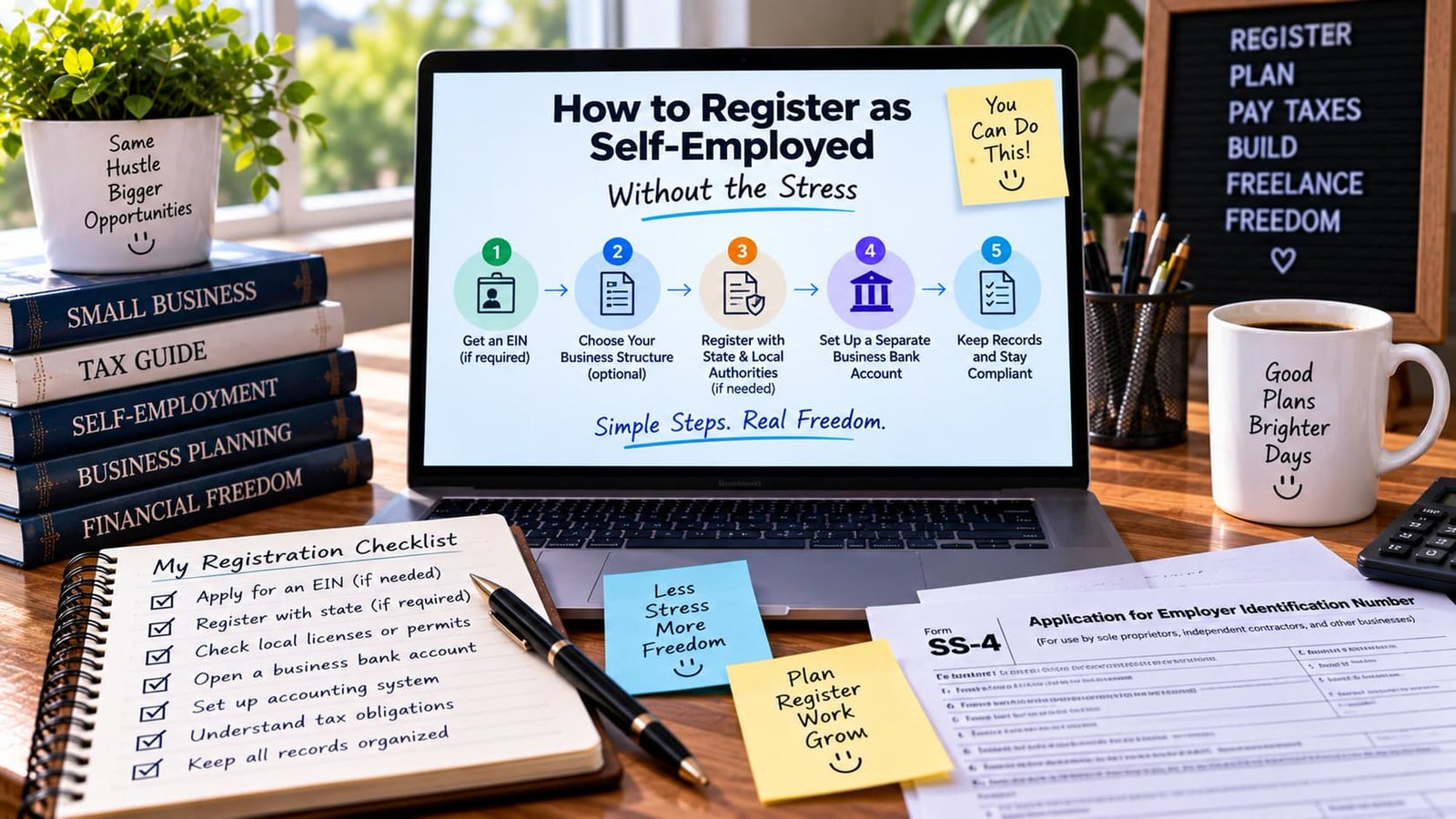
Quick answer: There’s no single federal “self-employment registration.” What you actually need is a five-step sequence — get an EIN if you want one, decide on a business structure, register with your state and local authorities only if your situation requires it, open a separate bank account, and keep records that make everything downstream easier.
Step 1: Get an EIN (if required)
An Employer Identification Number isn’t required for a sole proprietorship with no employees — you can file Schedule C using your Social Security number instead. That said, many freelancers apply for one anyway, for free, directly through the IRS, simply to avoid handing out their SSN on every client W-9 form. If you plan to hire anyone or eventually elect S-corp taxation, an EIN becomes mandatory at that point.
Step 2: Choose your business structure (optional)
You don’t have to decide anything here to start working — doing nothing makes you a sole proprietorship by default. If you’re weighing whether to form an LLC instead, see LLC vs. Sole Proprietorship: Which Is Best for Freelancers? before committing to either.
Step 3: Register with state & local authorities (if needed)
This is the part that varies the most and causes the most confusion, precisely because there’s no single national answer. Common things to check for your specific city/state:
- A general business license or home-occupation permit from your city or county
- A DBA (“doing business as”) filing if you’re operating under a name other than your own
- A state sales tax permit, if you sell physical goods or certain taxable services
- Industry-specific licensing (contractors, cosmetologists, certain consultants, financial advisors, etc.)
Many purely service-based freelancers (writers, designers, consultants working remotely) need none of these — but it’s worth a quick check with your city or county clerk’s office rather than assuming either way. Skipping a genuinely required local license is a more common problem than most freelancers realize, and it’s usually inexpensive and fast to fix once you know it’s needed.
Step 4: Set up a separate business bank account
Open a dedicated account for business income and expenses even if you never register a formal entity. This single habit does more to reduce tax-season stress than almost anything else on this list — mixing personal and business transactions in one account is the top reason self-employed filers struggle to reconstruct their numbers accurately.

Step 5: Keep records and stay compliant
Whatever your local requirements turn out to be, this is the step that actually protects you long-term: consistent bookkeeping, a plan for quarterly estimated taxes, and records organized as the year happens rather than reconstructed from memory in April.
- Apply for an EIN (if needed)
- Register with your state (if required)
- Check for local licenses or permits
- Open a business bank account
- Set up an accounting system
- Understand your tax obligations
- Keep all records organized
The step that actually matters most
Whatever local licensing turns out to apply, the thing that genuinely keeps you out of trouble is the same regardless of jurisdiction: accurate records and a quarterly tax habit. Start with the Self-Employment Tax Calculator and the 1099 & Quarterly Tax Calculator as soon as you have income coming in, and get comfortable with Schedule C early — it’s the document every other step ultimately feeds into.
How to actually check your specific local requirements
Rather than guessing, the most reliable path is contacting your city or county clerk’s office directly, or checking their official website’s business licensing section. Many cities also have a small business development office or chamber of commerce that can point you toward the exact requirements for your specific type of work — this is often faster and more accurate than searching generically online, since requirements genuinely vary block by block in some metro areas with multiple overlapping jurisdictions.
What happens if you skip a required local license
Consequences vary widely by jurisdiction — some areas simply require you to obtain the license retroactively with a small fee once discovered, while others impose more meaningful penalties for operating without required registration. Because the range of outcomes is wide and location-specific, it’s not worth assuming the risk is always minor; a quick check up front is almost always less costly than dealing with a compliance issue after the fact, especially if it surfaces during a dispute with a client or an audit of some kind.
A simple way to think about the whole registration question
Federal tax registration (filing Schedule C) happens automatically the first time you report self-employment income — there’s genuinely nothing to apply for in advance there. Local registration is the only piece that requires active research, and it’s usually a one-time task rather than an ongoing burden once it’s done. Treat it as a single afternoon of research early on, not a recurring source of anxiety.

What to do once you’ve confirmed your requirements
Once you’ve identified exactly what your city, county, and state require, most of the actual registration steps can be completed online in a single sitting for the majority of jurisdictions — application forms, fee payment, and confirmation typically happen within the same digital session rather than requiring an in-person visit. Save confirmation numbers, receipts, and any issued license documents in the same organized folder where you keep your other business records, since you may need to reference or renew these periodically, and having them easily accessible saves real time later.
Renewal requirements you shouldn’t overlook
Many local business licenses and permits require periodic renewal — annually in many jurisdictions — and it’s easy to register once, forget about it, and inadvertently let a license lapse. Set a calendar reminder tied to your renewal date rather than relying on a renewal notice arriving reliably by mail, since a lapsed license can create the same compliance problem as never registering in the first place, just discovered later and with less warning.
A realistic first-week action plan
Rather than treating registration as one overwhelming task, break it into a simple sequence: first, confirm whether you actually need any local licensing at all by checking your city or county’s website or calling their business licensing office directly. Second, decide whether to apply for an EIN (a five-minute process directly through the IRS website if you choose to). Third, open your dedicated business bank account, which most banks can set up same-day with minimal paperwork for a sole proprietorship. Fourth, set up a simple system — even a basic spreadsheet — for tracking income and expenses from your very first dollar earned.
Completed in this order, most of this realistically takes a few hours spread across a week, not the extended, anxiety-inducing process it can feel like when the individual steps aren’t broken down clearly. The goal isn’t perfection on day one — it’s having the basic structure in place before your bookkeeping and tax situation becomes complicated enough that retrofitting good habits becomes a real chore.
A quick word on sales tax permits specifically
If your work involves selling physical products or certain taxable services, a state sales tax permit is one of the more commonly overlooked registration steps, since many service-based freelancers never need one and simply don’t think to check. If you sell anything tangible — even occasionally, alongside primarily service-based work — verify your state’s specific threshold and requirements for sales tax collection separately from the general business licensing questions covered above.
Bottom line
Don’t let uncertainty about local licensing delay you from earning. Most of what stresses people out about “registering” as self-employed is a state or city question, not a federal one, and it rarely blocks you from simply starting the work — file Schedule C when tax time comes, and handle the local details in parallel rather than treating them as a prerequisite.
Related guides
- How to Become an Independent Contractor: A Step-by-Step Guide
- Sole Proprietorship vs. Independent Contractor: What Is the Difference for Tax Purposes?
- Can Sole Proprietors Have Employees? What You Need to Hire Legally
- How to Transition from Full-Time Employee to Successful Freelancer
- Independent Contractor Lawyer: When You Need One and What It Costs