
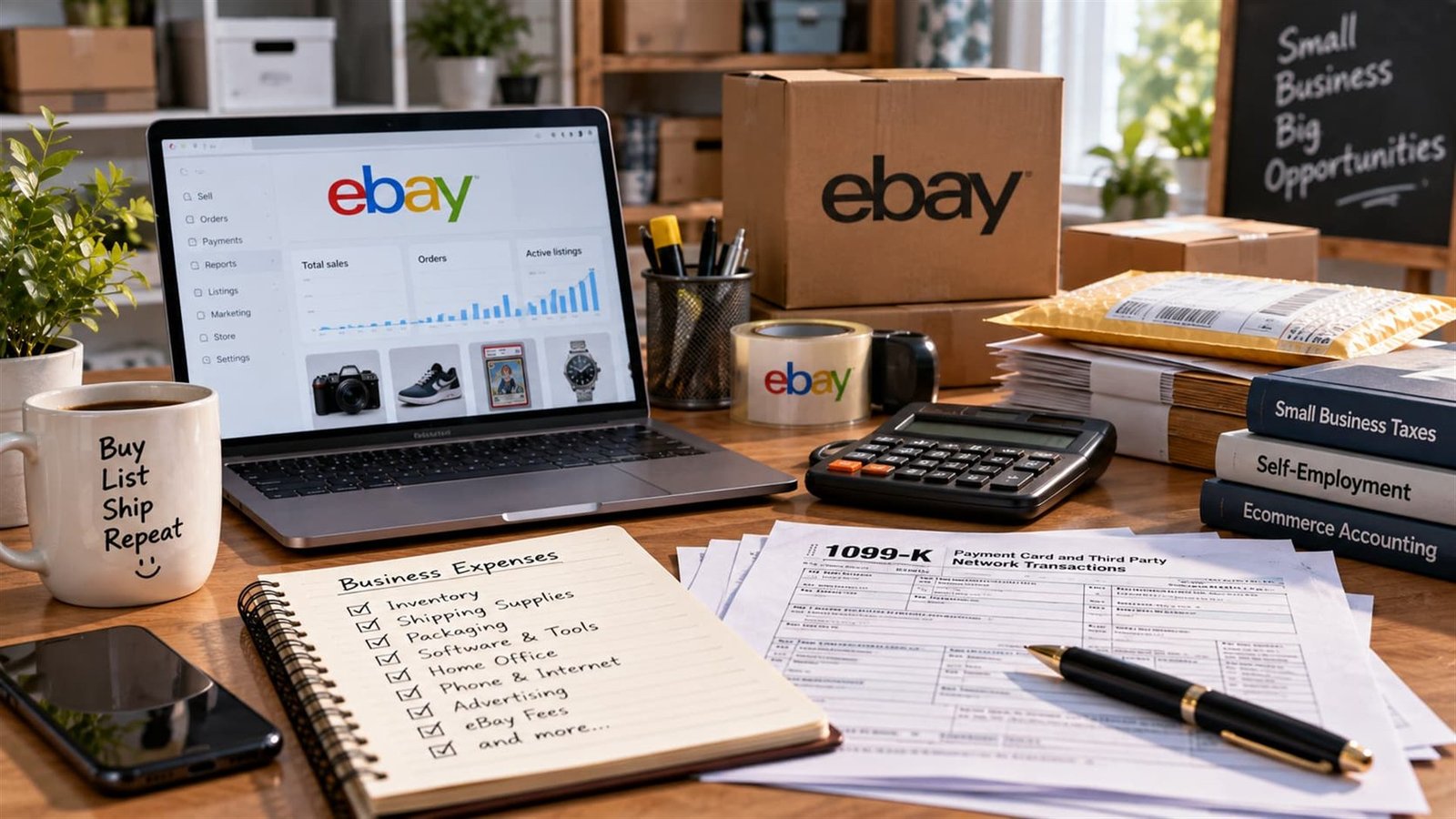
✅ Current for tax year 2026
How the 1099-K threshold changed for online sellers, and how to tell real profit from money that was never taxable.
Quick answer: eBay is required to send you a 1099-K if your sales cross the federal threshold for the year — and that threshold has changed dramatically over the last few years. For 2026, it’s back to $20,000 and 200 transactions, not the $600 figure that was scheduled to take effect before Congress reversed it.
Why this keeps changing
The 1099-K threshold has been on a genuine rollercoaster. A 2021 law dropped it to $600 with no transaction minimum, phase-ins got delayed repeatedly, and the 2025 One Big Beautiful Bill Act (OBBBA) reversed course entirely, restoring the original $20,000-and-200-transactions threshold for 2025 and beyond. If you’ve seen conflicting numbers online, that’s why — a lot of still-indexed articles describe rules that no longer apply.
Below the threshold doesn’t mean tax-free
This is the part that trips people up: not receiving a 1099-K doesn’t mean the income isn’t taxable. If you’re regularly buying and reselling items for profit, that’s self-employment income you’re required to report whether or not eBay sends you a form.
Selling personal items is different from running a business
If you’re selling your own used furniture or old electronics for less than you paid for them, that’s generally not taxable — you’re not making a profit. The 1099-K rules exist to catch business-like reselling activity, not to tax you for cleaning out your garage. Where things get genuinely taxable is consistent buying-to-resell, or selling handmade goods, at a profit.
What counts as your taxable income
Your 1099-K shows gross payment volume — before eBay’s selling fees, shipping costs you paid, and the cost of the item itself. Your actual taxable profit is revenue minus those costs, which is usually a much smaller number than the 1099-K total.
If eBay selling is your main income
Once it’s a real, ongoing business rather than occasional resale, your net profit becomes self-employment income subject to self-employment tax — the same 15.3% that applies to any other 1099 work. Run your numbers through the 1099 & quarterly tax calculator once you know your net profit.
Figuring your actual cost basis
Your taxable profit isn’t sale price minus zero — it’s sale price minus what the item cost you to acquire and sell. For items you bought specifically to resell, that’s your purchase price plus what you paid to get them (shipping in, restoration costs, marketplace fees). For personal items you’re finally selling, it’s usually your original purchase price, even years later — a couch you paid $800 for and sell for $300 has no taxable gain, because you sold it for less than you paid. Keep receipts or reasonable records of what things cost you; without them, the IRS can require you to treat the entire sale price as profit, a much worse outcome than doing the bookkeeping upfront.
A quick example
Say you buy items at thrift stores for $3,000 total across the year and resell them on eBay for $9,500, paying $650 in eBay and payment processing fees and $400 in shipping supplies. Your taxable profit is $9,500 − $3,000 − $650 − $400 = $5,450 — not the full $9,500 shown on any 1099-K you receive, and definitely not the $20,000 threshold figure itself, which only determines whether a form gets issued, not what you actually owe.
Sales tax is a separate question
Everything above concerns federal income tax — sales tax is a completely separate system, handled differently. In most cases, eBay itself collects and remits sales tax on your behalf under marketplace facilitator laws that most states have adopted, meaning you typically don’t need to separately collect or file sales tax on eBay sales even as a regular seller. That’s different from income tax, which you’re always responsible for regardless of what the marketplace collects on transactions. Don’t assume that because eBay handles sales tax collection, your income tax obligation is also handled — the two systems operate independently, and confusing them is a common and costly mistake for newer resellers scaling up from occasional sales into a real side business.
Sources
1099-K threshold history reflects the American Rescue Plan Act’s original change and its reversal under the 2025 One Big Beautiful Bill Act — see the IRS’s official Form 1099-K page for current rules.