
✅ Current for tax year 2026
Why Dashers are contractors, not employees, what the 1099-NEC reports, and what that means for your taxes.
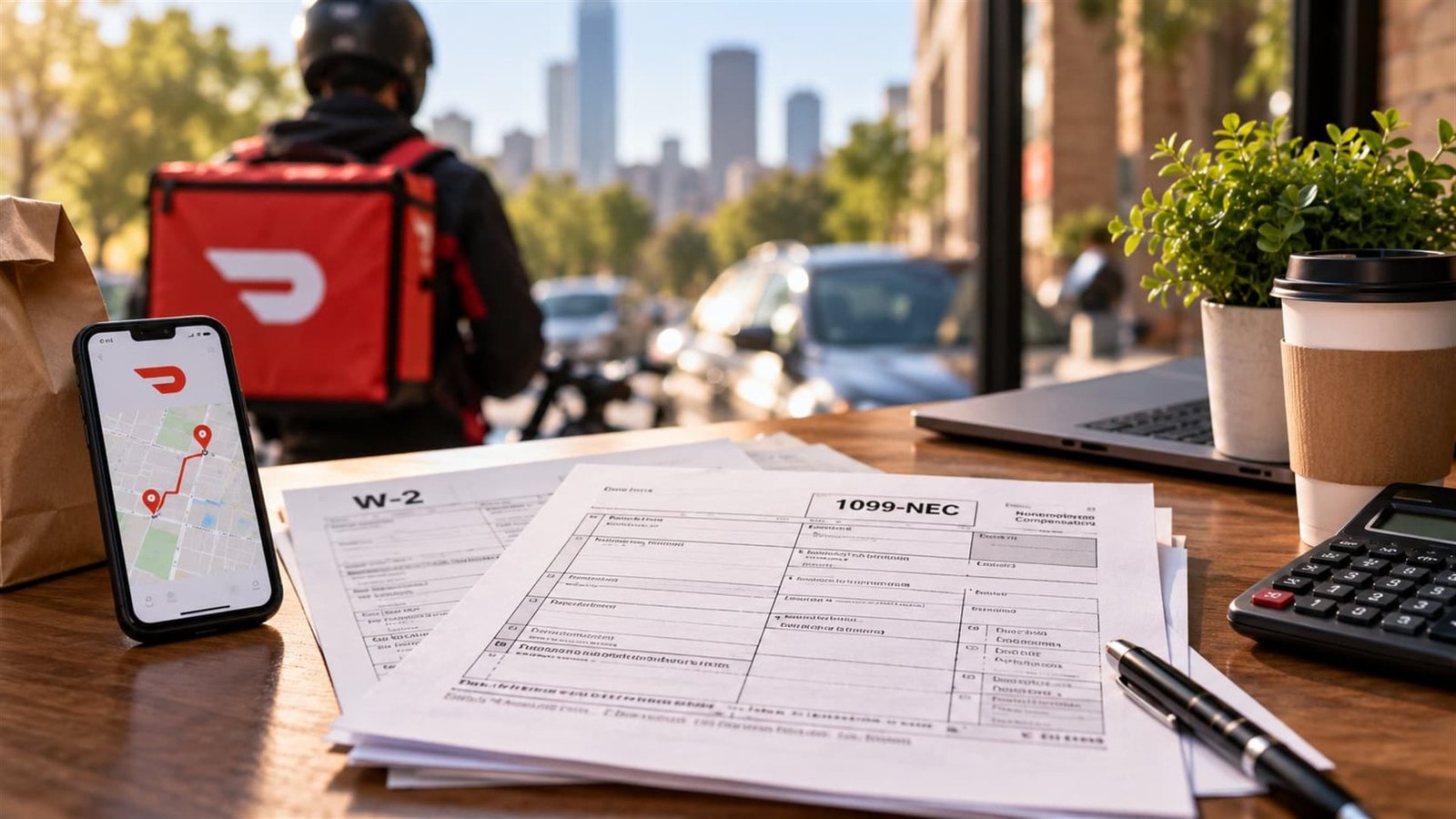
Quick answer: No — DoorDash doesn’t send Dashers a W-2, because Dashers aren’t employees. If you earned $2,000 or more delivering in 2026, DoorDash sends you a 1099-NEC instead, and that one-letter difference changes everything about how you owe tax.
What DoorDash actually sends you
A W-2 means an employer withheld income tax, Social Security, and Medicare from every paycheck, and paid half your FICA tax for you. A 1099-NEC means none of that happened — DoorDash paid you your full fare and tips with nothing withheld, and reporting and paying tax on it is entirely on you. The 1099-NEC arrives (mail or through the Stripe Express/Everlance-style dashboard DoorDash uses) by January 31 for the prior year, showing your total non-employee compensation.

Why this trips people up
Dashers who’ve only ever had W-2 jobs are sometimes surprised that nothing was withheld all year — meaning the amount they actually owe in April (or across quarterly payments) can be thousands of dollars they didn’t see coming. You’re classified as an independent contractor, which is also why DoorDash doesn’t provide paid time off, health insurance, or a 401(k) match — the trade-off for flexibility is that you’re running your own small business, on paper, whether it feels like it or not.
What if you earned under $2,000?
The 1099-NEC threshold jumped from $600 to $2,000 starting with the 2026 tax year — so more Dashers than before won’t receive a form at all. That doesn’t change what you owe: you’re still legally required to report all your self-employment income to the IRS regardless of whether a form arrives. “No 1099” does not mean “no taxable income.”
What this means for your tax bill
Your 1099-NEC total isn’t your taxable income — it’s your gross. From there, you subtract your business expenses (mileage, phone, hot bags, and more) to get your net profit, which is what actually gets taxed. That net number is what you’d plug into the 1099 & quarterly tax calculator to see your self-employment tax and estimated payment.
Next: what you can actually deduct
The gap between your 1099-NEC total and your real tax bill is entirely made up of deductions you’re allowed to take as a Dasher — see the full breakdown in the full DoorDash deduction list.
Driving for more than one app?
Many Dashers also drive for Uber Eats, Instacart, or Grubhub in the same year. Each platform issues its own 1099-NEC (or nothing, if you stayed under that platform’s individual $2,000 threshold) — there’s no combined form. Add up every platform’s total, plus any unreported cash tips, to get your real gross self-employment income. The IRS doesn’t average the threshold across apps, so it’s entirely possible to owe tax on income from a platform that never sent you a form at all, simply because you stayed under its own $2,000 cutoff while your combined total across apps was well above it.
A quick example
Say you drove for DoorDash and Uber Eats in 2026, earning $9,500 combined across both 1099-NECs, plus $600 in cash tips no platform tracked. Your gross self-employment income is $10,100 — not just the $9,500 shown on paper. After typical deductions (mileage, phone, gear), many Dashers land on a net profit 25-40% lower than gross; self-employment tax and estimated quarterly payments are based on that lower net number, not the raw total.
State-level worker classification rules
A handful of states have passed their own laws affecting how gig platforms classify drivers, separate from the federal 1099-NEC question addressed here. Even in states with stronger gig-worker protections, the federal tax treatment discussed in this article — 1099-NEC, not W-2, for most Dashers — generally still applies, since state labor classification and federal tax classification aren’t automatically the same thing.
Sources
The 2026 threshold increase to $2,000 and 1099-NEC reporting rules come from the IRS’s official Form 1099-NEC page. Independent contractor classification follows the IRS self-employment tax overview.